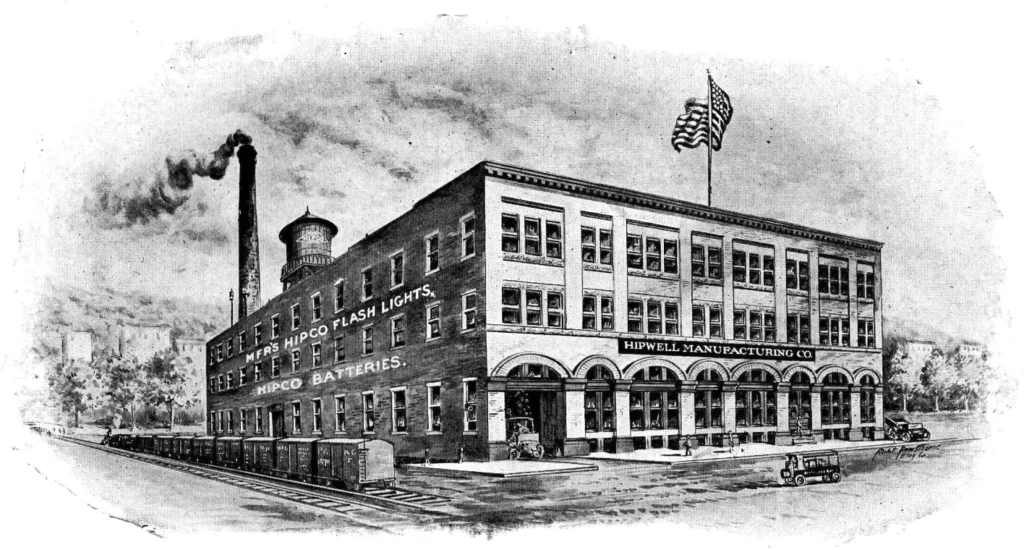

This was a warehouse, with offices and showrooms, built in 1907 for a company that sold a wide variety of products, from ball-bearing grinders to home appliances—including, according to a comment below, an automobile called the Duquesne, which never made it into full production, and about which Father Pitt would like to hear more from anyone who has information. (Note, by the way, that the company’s owners were among the many stubborn Pittsburghers who kept the H at the end of the city’s name through the dark days when it was officially banned.) Its 1913 catalogue is more than two thousand pages, and the title page shows us why so much effort went into making this industrial building attractive: because it had to look good in the engraving.

This picture—which is probably the architects’ rendering, since the same picture shows up in other sources even before the building was completed—shows the building before it was expanded. The architects were the William G. Wilkins Co., designers of numerous warehouses and industrial buildings in Pittsburgh, including the Frick & Lindsey Co. warehouse, now the Andy Warhol Museum. The addition to the left of the building was built in 1919 or 1920; the same architects supervised it, so it matches the rest very neatly. William Glyde Wilkins was an engineer; to do the architecting in his firm, he had the very capable Joseph F. Kuntz, who loved terra-cotta decoration.


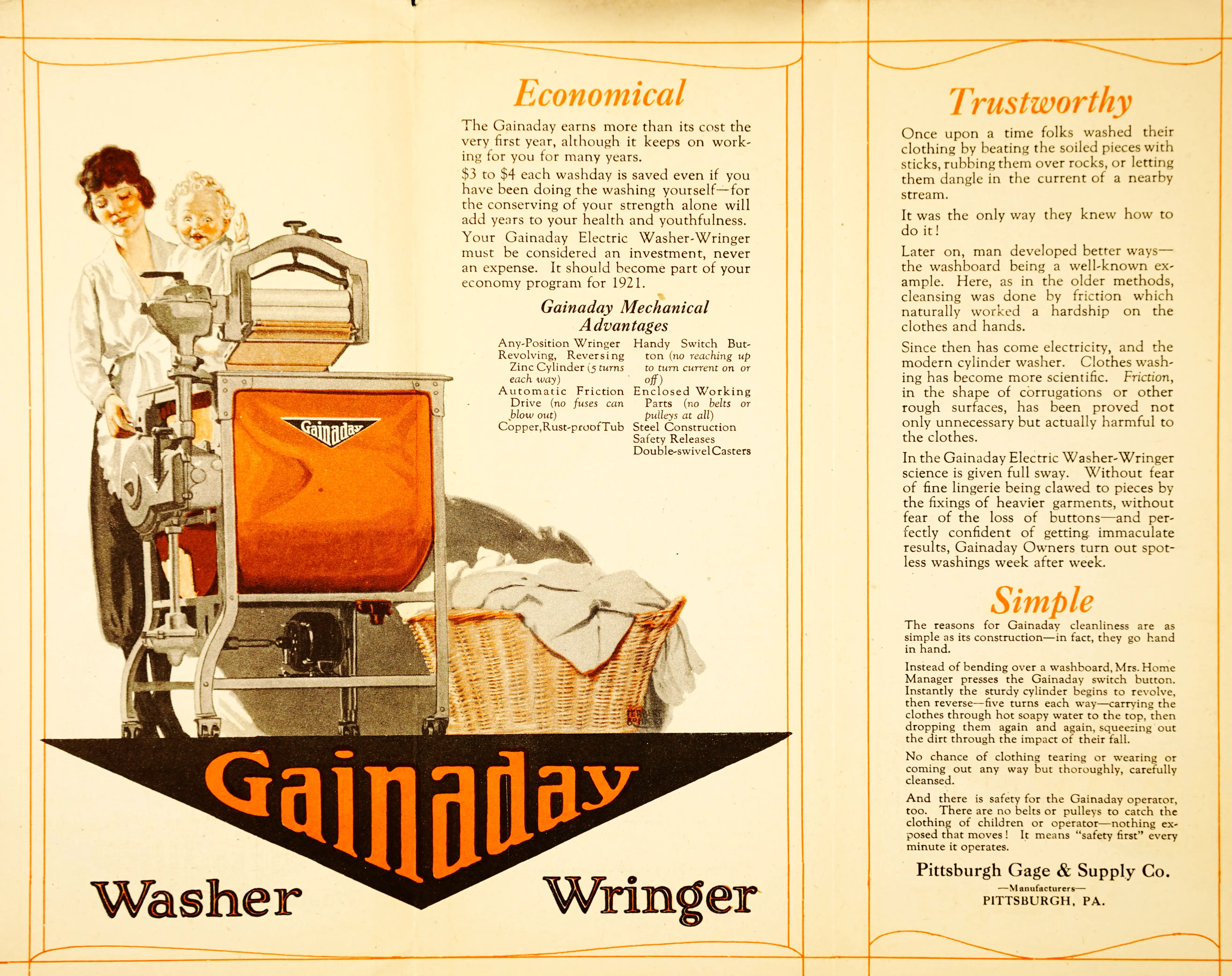
One important line the company sold was the Gainaday brand of home appliances. In the early part of the twentieth century, middle-class families were learning to live without servants. It meant the housewife had to do the work previously done by maids and housekeepers. But this was the mechanical age: a machine could take the place of a servant. It was so efficient, in fact, that you could gain a day over the course of your week of housewifely duties.
The building was promoted as a “model warehouse,” a shining example of what could be done with this sort of building, and Pittsburgh’s Standard Sanitary Manufacturing Company, the biggest name in toilets (which later merged with American Radiator to form American-Standard), took out a full-page ad in a journal of the toilet trade to boast that the plumbing fixtures were all Standard brand.

The magazine Rock Products for November 22, 1907, gave a detailed description of the building as it was going up, with—once again—the same illustration.
Pittsburg Gage and Supply Company.
The immense building now being erected by the Pittsburg Gage and Supply Company at Thirtieth Street and Liberty Avenue, Pittsburg, Pa., is constructed of steel, brick and concrete fireproofing, equipped with automatic sprinklers throughout, and when completed will be the largest, most modern and thoroughly equipped supply house in the world.
For the concrete work Lehigh Portland cement was used throughout. The W. G. Wilkins Company, Westinghouse Building, were the architects, and the George Hogg Company the contractors.
The first floor will be used as a general salesroom; the second floor will be taken up by the offices and shipping departments of the company. All the other floors and the basement will be used as storage space for their mammoth stock. A notable feature of the main building is the central_tower rising more than forty feet above the roof. In this tower will be located water tanks holding 65,000 gallons, which will be used for the house supply and the automatic sprinkler system.
In connection with the building there is being erected a six-story fireproof building, in which will be manufactured the Pittsburg steam specialties. It will also contain a thoroughly modern brass foundry and pipe shop. Electric cranes are to be used throughout, and all machinery, elevators, etc., will be electric-motor-driven.
A joint siding of the Pennsylvania, Baltimore and Ohio and Pittsburg Junction railroads will afford excellent shipping facilities. Adjoining this siding they are constructing a large iron, steel and pipe warehouse, in which will be carried the largest stock in Pittsburg, if not in the Central States. Adjoining this building there is a vacant frontage of almost 100 feet, which will be used for storage and switching purposes.
The present stores and warehouses of the Pittsburg Gage and Supply Company are located at 309-321 Water Street, and its manufacturing plant at Thirty-first Street. The officers are: W. L. Rodgers, president; J. Lee Rodgers, secretary; R. F. Ramsey, treasurer; A. F. Maxwell, assistant treasurer; M. R. Porter, sales manager, and H. E. Haller, superintendent.
Comments