
When Pittsburgh was just a frontier town far from the civilized East; when the American Revolution was not yet won; when wars with Indian nations kept Pittsburghers looking over their shoulders every time they left their mostly log houses—one extraordinary man came here to Pittsburgh with the idea that, if he could not find civilization here, he would make it.
Hugh Henry Brackenridge was at Princeton with James Madison and Philip Freneau, where they founded the American Whig Society. Already in college Brackenridge was scribbling furiously. He and Freneau wrote the commencement poem in 1771—“The Rising Glory of America.”
When the Revolution broke out, Brackenridge was not one of the military leaders. But he was the first to write a blank-verse tragedy on the Battle of Bunker Hill, which was performed by the students at the Somerset Academy. Brackenridge was master of the school: it is a good principle for dramatic writers to remember that, if they have difficulty rounding up actors, they can take over a school and simply require the students to perform their work.
In 1778, Brackenridge tried founding a magazine in Philadelphia; but in spite of sharp and clever writing by Brackenridge and his friend Freneau, the publication could not make money. So Brackenridge studied law; but Philadelphia was already stuffed with lawyers.
But Pittsburgh, three hundred miles to the west, had none.
In 1781, therefore, Brackenridge moved to Pittsburgh, where he could make something of himself by making something of the place.
Brackenridge was always involved in politics, and he often held political office—culminating in a seat on the Supreme Court of Pennsylvania. But literature was his first love. In politics he had to adapt to the whims of the people; in writing, frequently under pseudonyms, he could say what he liked, and indeed contradict himself as much as he pleased. Brackenridge was a man of well-considered contradictions. He was a lifelong believer in the American experiment, and fought hard for the ratification of the Constitution; but he was a thorough cynic as well. He was able to balance the two contradictory ideas that it was right that the people should rule, and that “the people are fools” and would botch the job completely given half a chance. The Constitution was important to him precisely because it also is a careful balance between those two contradictory ideas. “No man was a more convinced democrat than Brackenridge,” said the 1917 Cambridge History of Literature, “but he was also solid, well-read, and deeply bored by fools who canted about free men and wise majorities.”
As a literary man, what outlet would Brackenridge have in a town of less than a thousand people? None whatsoever when he arrived; but he backed an ambitious fellow named John Scull, financing the hauling of a printing press across the mountains. The result was the Pittsburgh Gazette—still clinging to life today, under the name Pittsburgh Post-Gazette, as the second-oldest metropolitan newspaper in America and one of the oldest in the world. The Gazette’s columns were filled with clever articles by many correspondents with comical names, most of whom were Brackenridge.
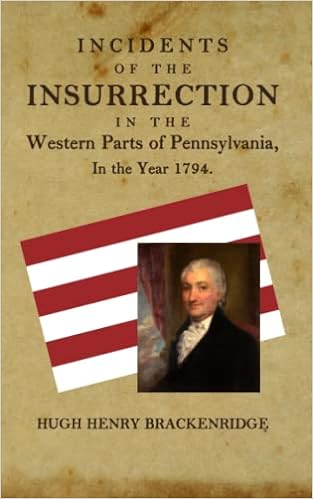
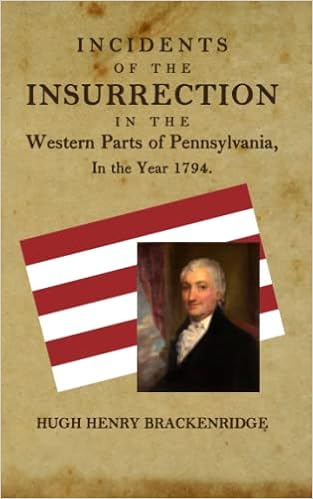
Brackenridge does not loom large in the standard histories of the United States, but it is arguable that his delicate tightrope act in the Whiskey Rebellion saved the young nation from civil war. His memoir of those times, Incidents of the Insurrection in the Western Parts of Pennsylvania in the Year 1794, is in print from our friends at the Franklin Head, and it is not only vital history but also first-class entertainment.
The work for which Brackenridge was long remembered, however, was Modern Chivalry, the first important novel published in America. If you look up “first American novel,” you will probably be led to The Power of Sympathy, which was published three years before the first volume of Modern Chivalry came out; but no one read The Power of Sympathy until it was rediscovered in the late 1800s, when it was given a second chance for no one to read it. Everyone read and laughed over Modern Chivalry, and it remained in print for a generation after Brackenridge had died. The book collector Charles Frederick Heartman believed that it would have been an acknowledged classic if it had been published in Europe. “Millions of copies would have been printed of this book and every bookseller would have a half dozen editions on his shelves. As it is but few people know that such a book was ever written, and fewer still have read it. It is, in fact, one of the greatest novels ever written in the English language. One has to borrow names like Swift, nay, Rabelais, to find equals.”
John Quincy Adams was one of the many early fans of the book. After a Pittsburgh friend sent him a new edition of Modern Chivalry in the 1840s, Adams wrote back,
I had read the first part of Modern Chivalry and formed a pleasant acquaintance with Captain Farrago and his man Teague, at their first appearance more than half a century since, and they had then excited much of my attention as illustrations of life and manners peculiar to the times and localities, not entirely effaced when I became more familiarly acquainted with them, by this visit to the latter.… The reappearance of this work, as a second edition, since the author’s death, more than half a century after its first publication, well warrants the prediction that it will last beyond the period fixed by the ancient statutes, for the canonization of poets, a full century. I shall read it over again, I have no doubt, with a refreshing revival of the pleasure with which I greeted it on its first appearance; and if this expression of my opinion can give any satisfaction to the remaining relatives of Judge Brackenridge, or to yourself, it is entirely at your disposal, being with a vivid sense and grateful remembrance of your kindness, and that of my fellow-citizens of Pittsburgh and Allegheny.
Dr. Boli’s Eclectic Library has a number of copies of Modern Chivalry, along with a few other critical assessments.
Judge Brackenridge left an equally literary son, Henry Marie Brackenridge, whose family founded the borough up the Allegheny that still bears their name.
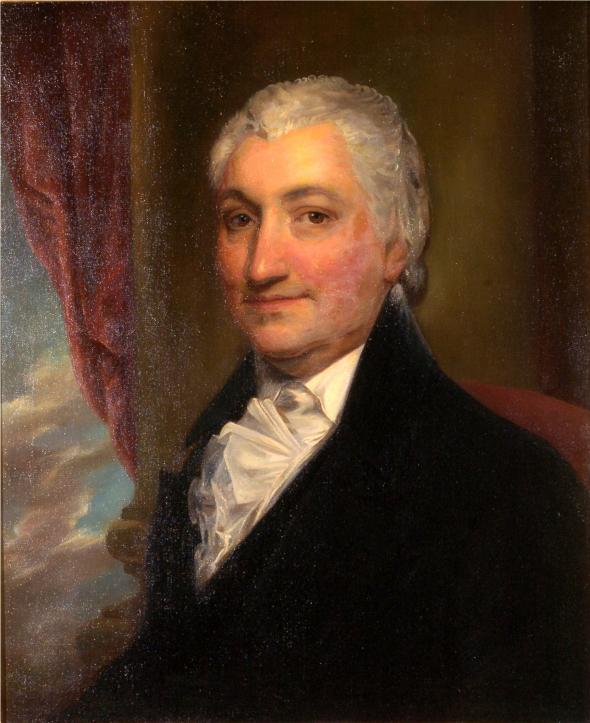
We might add that the portrait at the head of the article belongs to the University of Pittsburgh—a school that was another gift of the far-seeing Hugh Henry Brackenridge to his adopted city. It was painted by Gilbert Stuart, whose most famous work is the portrait of Washington adapted for our dollar bill.
Comments