

A frame Victorian house of the sort that makes Shadyside such a pleasant neighborhood to go walking in. Various alterations have been made, but they have been in sympathy with the original design.
Comments
A frame Victorian house of the sort that makes Shadyside such a pleasant neighborhood to go walking in. Various alterations have been made, but they have been in sympathy with the original design.

The eastern part of Howe Street grew a fine collection of upper-middle-class houses around the turn of the twentieth century. Here are three in three different styles, beginning with a fine Dutch colonial. The entrance has been altered to make the house an apartment building, but otherwise the details are in good shape.

Here is a sturdy foursquare house with Queen Anne details.


Finally, a Tudor with an imaginative randomness made even more random by later alterations and additions.

Here is another of those apartment buildings that stare back at you when you stare at them.

The St. Regis was built in 1908; the architects were the Chicago firm of Perry & Thomas, who designed several other apartment buildings in Shadyside and Squirrel Hill.


Perry & Thomas seem to have absorbed an eclectic assortment of styles from Beaux Arts through Art Nouveau to Prairie Style. These entrances have the graceful and almost decadent curves we associate with Art Nouveau. They are very similar to the entrance to the Emerson, an apartment building put up two years earlier. That building is attributed to Samuel Crowen, another Chicagoan; but Crowen was associated with Perry & Thomas, and there is certainly a more-than-coincidental resemblance—not only in the entrances, but also in the balconies, which in both buildings are framed by supports ending in decorative faces. The ones on the Emerson are much more abstract, but the idea is the same.
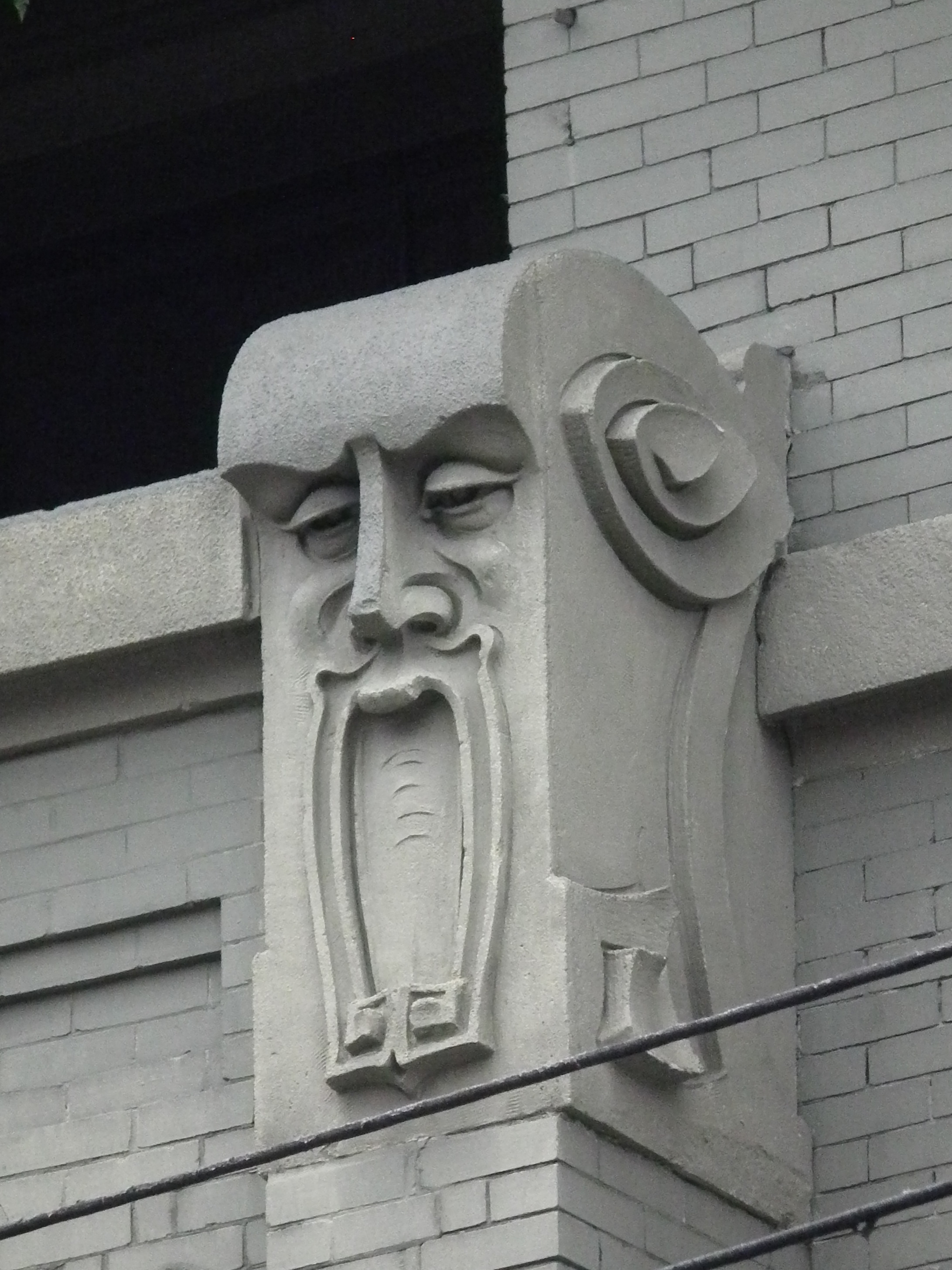
Face on the Emerson.

Faces on the St. Regis.
While taking these pictures, Father Pitt had a short conversation with the maintenance man, who tells us that the apartments were originally big and luxurious, but have been cut down to one and two bedrooms by the present owners. Expensive materials like marble abound inside the building.


Something interesting must lurk behind this wall along Howe Street.

As we step closer we notice the Pittsburgh History and Landmarks Foundation plaque, and we begin to get a view of the cottage beyond the wall.

The sheltering wall seems to be there less to conceal the house than to delight us with the revelation. This is the Nora McMullen Mellon house, built in 1911 from a design by Thomas Scott. The unusual (for Pittsburgh) choice of stucco with brick trim makes this English cottage stand out on the street, and the current owners keep it as pretty as an architect’s rendering.

Here’s a house in an eclectic style made up of bits of other eclectic styles, but they all fit together well. The heavy arches picked out in darker brick remind us of the Rundbogenstil, a word we like to say as often as possible; but the irregular picturesque arrangement of parts takes inspiration from the style that, in defiance of history, was called Queen Anne.


The turret has a well-preserved witch’s cap and a rim of foliage scrollwork.

The oriel and the porch pediment are both decorated with grotesque foliage ornaments.


The house next door is a duplicate, but reversed.

Finally, a house that shares the same general shape, but is distinguished by its shingly top with curved surfaces and ornamental swags and foliage picked out in contrasting paint.

Like many Shadyside houses, this one has automobiles burrowing under the porch.

This row of houses on Howe Street has a distinctly Dutch or Flemish look. The Flemish style is not unknown in Pittsburgh, but it is rare to see a row of five houses in that style at once. (For another example of multiple Flemish houses, see the Osterling row in Brighton Heights.)

This house, like many in Shadyside, has had part of its basement turned into a garage, with a steep driveway dug out of the front yard.

It is delightful to see that the intricate woodwork on the front porch has been preserved.


The angles and curves that make the gable look so Antverpian are made of iron or steel, as we can tell by one rusted section:

This makes us suspect that perhaps three of the other houses in the row might have had similar decorations, removed when they rusted too much to repair.


This house, however, was clearly meant to show off its stones without additional adornment, except for the usual decorative utility-cable swags.

Originally the Kent and the Howe, this pair of attached buildings was renamed for its most prominent decorative feature—the lion’s heads that preside over each entrance. The architects were the Chicago firm of Perry & Thomas, who were responsible for a number of apartment buildings in Shadyside and Oakland; they were especial favorites of the developer John McSorley.


A pair of identical apartment buildings, now known by their addresses (5758 Howe and 5754 Howe). They were built in 1908; the architect was C. J. Rieger. Though they have lost their cornices (which, to judge by the size of the scars, must have been elaborate), the rest of the details are well preserved, showing a Renaissance or Baroque style flavored with Art Nouveau.


