Tag: German History

  • Allegheny Turnhalle, Schweitzerloch

    Allegheny Turnhalle

    Old Pa Pitt does not indulge in clickbait headlines. If he did, the headline for this article would have been,

    This Picture Is Impossible (but We Did It Anyway).

    This building faces Canal Street, which is an absurdly narrow street. The other side of the street is a wall, on top of which trees grow, and behind them a railroad. So there is no way to stand back and get a picture of the front of the old Allegheny Turnhalle except by trickery. But Father Pitt has never been above trickery. The image above is not perfect, but considering the adverse circumstances it came out pretty well. It is made from ten separate photographs.

    The Allegheny Turnhalle was designed by Joseph Stillburg for the Turners of Allegheny; it is one of his few remaining large works. The original front was more elaborate, as we see in this picture from Preservation Pittsburgh.
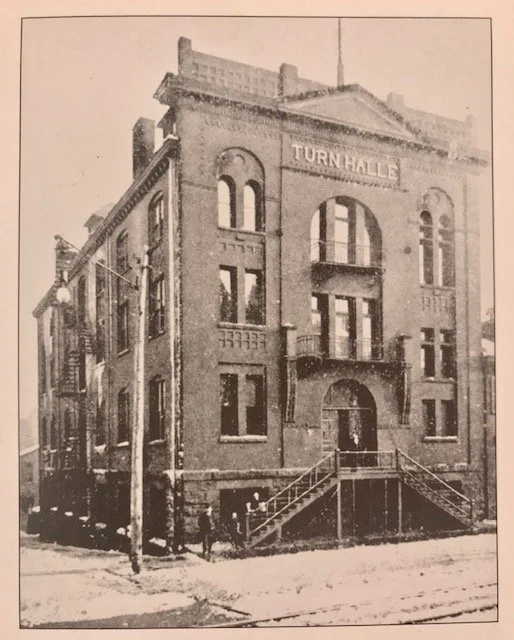
    Allegheny Turnhalle

    Here we see the adroit combination of classical and Romanesque detailing that marked Stillburg’s work—a style architectural historians like to call Rundbogenstil, because Rundbogenstil is much more fun to say than “round-arch style,” which is what the German word means. There was also an interesting diagonal asymmetry to the front, doubtless reflecting stairways in the interior. The current state of the building is the result of its conversion into a warehouse, which is what has saved it when almost all of the old Schweitzerloch neighborhood—an isolated rectangle just off the Sixteenth Street Bridge—has been razed to weedy vacant blocks.

    Cornerstone: Ecksteinlegung am 21. Juli 1889.

    The cornerstone tells us it was laid on July 21, 1889. Newspapers of the time tell us that about two thousand people were there to watch the ceremonies. Since they were Germans, there was probably good beer, too.

    Allegheny Turnhalle
    West side of the hall
    Rear of the building
    Canon PowerShot SX20 IS.

    What used to be a dense Swiss-German, and later Slovak, neighborhood is now mostly weeds and overgrown asphalt. It’s shocking that this emptiness is right across the river from the bustling Strip and a short stroll from the lively North Shore, but it’s hemmed in by railroads, bridges, and expressways.


    Comments
  • St. Walburga’s Church, Lincoln–Lemington–Belmar

    St. Walburga’s Church, now Cornerstone Baptist Church

    You never know what you might find when you go trawling in the depths of the archives. These pictures were taken in September of 2014, but old Pa Pitt never published them. Why not? His memory is vague, but he suspects it was because he was planning to publish them when he worked out the history of the building, and he never did work it out. Finding the pictures by random luck the other day stimulated him to finish the job, and here they are.

    The tower with dome

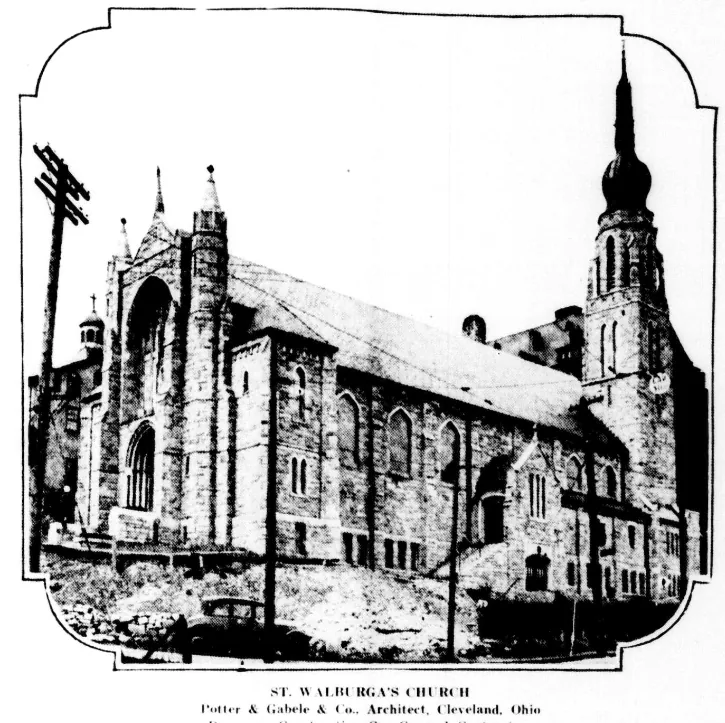
    St. Walburga’s was a German parish founded in 1903—the last ethnic German parish founded in the city of Pittsburgh. The cornerstone of this building was laid in April of 1927; the building was dedicated a year later in April of 1928. The architects were the Cleveland firm of Potter & Gabele & Co., and if Father Pitt told you how much time he spent trying to find that information before finally locating it in the Pittsburgh Catholic for April 19, 1928, you would wonder a little about whether he should be regarded as competent to manage his own life.

    St. Walburga’s in 1928
    The church at its dedication, from the Pittsburgh Catholic, April 19, 1928, p. 3. Almost nothing has changed externally.

    J. Ellsworth Potter was a successful architect who designed churches in traditional styles until his death in 1958. Henry Charles Gabele was associated with Potter until 1932, but after that seems to have fizzled out as an architect (see a brief notice in this PDF Cleveland Architects Database).

    Tower

    St. Walburga’s parish was suppressed in 1966, a victim of postwar demographic change. Today the building belongs to the Cornerstone Baptist Church, whose congregation obviously treasures it and keeps it in beautiful shape.

    West front

    St. Walburga’s Church
    Konica Minolta DiMAGE Z3; Kodak EasyShare Z1485.
    Comments