George S. Orth was the architect of this school, one of the first large institutional buildings in the Oakland district. It was built in 1894, and it still serves its original institution.
The style is a sort of Flemish Renaissance filtered through Americanized Rundbogenstil. The horizontal stripes in the brickwork are such an instantly distinctive feature that they have been imitated in the school’s modern additions.
George S. Orth, who lived in Bridgeville, designed this building,1 which was put up in two stages, beginning in 1903 or 1904, for the Bridgeville Trust Company. If you look very carefully, you can see the seam in the middle of the long side along Station Street, marking the line between the original square building on the corner and the later addition behind it. At some time in the middle twentieth century, the ground floor was entirely redesigned to look more like a modern bank, so that only on the second floor is Orth’s work visible today. The building was still a bank (a branch of PNC) until just a few years ago.
Across the street, the First National Bank of Bridgeville was going up at the same time. James E. Allison was the architect of this one.2 Soon—probably while this building was still going up—he would take his brother David on as a partner in the firm of Allison & Allison. In 1910 they moved to Los Angeles, and they flourished there as architects of some of the most notable buildings in the city.
Record & Guide, November 18, 1903, p. 763. “At Bridgeville, Allegheny county, the First National Bank will erect a building two stories high, of stone and brick, all modern conveniences. The plans have been prepared by J. E. Allison, Westinghouse Building, Pittsburg, Pa.” The building ended up with three floors, but Hopkins maps show the First National Bank at this location. ↩︎
According to Wikipedia and the National Register of Historic Places and the Pittsburgh History and Landmarks Foundation and numerous books and so on and so forth, the architects of Westinghouse High School were Ingham & Boyd. So you can just take the story as it comes to you, or you can can do what Father Pitt can’t stop himself from doing: keep pulling at a loose thread until the whole story unravels and has to be woven again.
The loose thread was that old Pa Pitt kept running across construction listings that said George S. Orth & Brother were designing a Homewood-Brushton High School in the middle teens of the last century. For a long time Father Pitt had just assumed that the project fell through, and later Ingham & Boyd were hired to design the school that was actually built in 1921. But then he found this elevation of the school as designed by the Orths:
It was printed in the Year Book of the Pittsburgh Architectural Club, Incorporated, for 1916—long before the current school was built in 1921. But even a casual glance shows that it is fundamentally the school that stands today. Details are different, but the three-arched entrance, the blank walls on the projections at the ends of the building, the exact number and proportion of the windows, and so on, are all the same.
So why are the Orths not credited as the architects of Westinghouse?
The Wikipedia article on Westinghouse High School explains it, though without mentioning the change of architects. Digging for the foundation of the school began in 1915, while the Orths were still frantically scribbling their final drawings. But then the bids from the construction contractors came in, and they were shockingly high. The school board decided to wait for a little bit. Then there was a big war, and the construction didn’t actually begin until 1921.
So much we can learn from Wikipedia. The article does not mention the Orths, however, so it does not inform us that George S. Orth died in 1918, and Brother (his name was Alexander Beatty Orth) died in 1920. Having gone to a better place, the Orths were not inclined to finish the supervision of the project, so new architects had to be found. Enter Ingham & Boyd.
Comparing the Orths’ drawing with the school as it stands shows us that Ingham & Boyd took over the original plans, but adapted them to their own taste. They made the design more rigorously classical, changed the partly brick walls to all stone, simplified the ornamentation, and added inscriptions (a typical Ingham & Boyd touch) to the blank walls. But the main outlines were already established by George S. Orth & Brother.
Having sifted through the history of Westinghouse High School, we must say that Ingham & Boyd did the larger part of the work. They not only remade the plans in a more modern style, but also supervised the construction and dealt with the school board as the costs kept rising, which must have required patience and many soothing words.
But the original design belongs to George S. and Alexander Beatty Orth, and they deserve the credit for it. It will probably take a long time for that truth to percolate through the many repositories of Pittsburgh architectural history. But, as the book of I Esdras says…
George S. Orth was the architect of this palace of education, which was finished in 1894. It’s a little bit Flemish Renaissance, with eye-catching horizontal stripes and Rundbogenstil eyebrows over the arches.
This building—a remnant of the pre-skyscraper age on Seventh Avenue—has been many things in its life. These days it is known only by its address. For a long while it was the Federated Investors Building. In 1923 it belonged to the Stevens & Foster Co., which Father Pitt believes was a maker of steel pens. In 1910 it was marked Geo. A. Kelly Co. Wholesale Drugs. Before that, it belonged to J. N. McCullough. It was built in the 1890s on the site of the First United Presbyterian Church, whose congregation had moved to the East End.
This is another one of those pictures where old Pa Pitt has created an impossible perspective by distorting different sections of the picture differently. Sometimes the best way to tell the truth about a building is with a little bit of fakery.
Addendum: The architect appears to have been George Orth & Brothers. Source: Philadelphia Real Estate Record and Builders’ Guide, May 19, 1897: “On the site of the First U. P. Church on Seventh avenue, a ten-story brick building will be erected by Mr. Harry Darlington. The plans will be made by Architects Geo. Orth & Bros., Stevenson building.” The building as it stands is four floors shorter, but buildings often shrank between initial announcement and final construction.
Colonial Place is one of those tiny enclaves all built at once in which Shadyside abounds. This one was built in 1898, and it is unique in that the entrance is flanked by two grand mansions.
George S. Orth was the architect of almost all the houses in Colonial Place. (See if you can guess which house old Pa Pitt thinks was not part of the original plan.) Mr. Orth had a prosperous career designing mansions for the wealthy, as well as some large institutions like the School for Blind Children. But he seems to have been forgotten faster than most Pittsburgh architects. He died in 1918; ten years later, when the architect George Schwan died at 55, his obituary in the Charette had to remind readers who Orth was: “He [Schwan] was trained in the office of George S. Orth, old time architect of Pittsburgh…” That is all the more remarkable because the Charette was the magazine of the Pittsburgh Architectural Club, of all groups the one that would be most likely to remember George S. Orth.
At any rate, Colonial Place is still a remarkably pleasant little street. The landscaping was done by E. H. Bachman, and the sycamores he planted still shade the street in summer and make a striking avenue in the winter with their stark white branches and trunks.
This mansion is currently the residence of the Greek Orthodox Metropolitan of Pittsburgh.
This one is currently for sale, and you can tour the interior on Google Street View (push the “Browse Street View images” standing-figure button to reveal little blue dots all over the house).
Colonial Place, off Ellsworth Avenue, is one of those little one-street enclaves in Shadyside that shut out the world as much as they can to create a tiny insular community. The architect here was George S. Orth, who also designed a couple of prominent millionaires’ mansions in Allegheny West. The landscape design by E. H. Bachman was just as important, and the sycamore trees he specified have matured into elegant sculptures as attractive when the leaves are off as they are in full leaf.
Harry Darlington built this house in 1908 for his son, Harry Darlington Junior. The son’s house was two doors down from the father’s (separated by the widow Holmes’ house), but the two houses could hardly be more different in style. Where the father’s is tall, narrow, and massive, this is (comparatively) low and spreading. The architect was George S. Orth, who also designed the William Penn Snyder house a block away on Ridge Avenue.
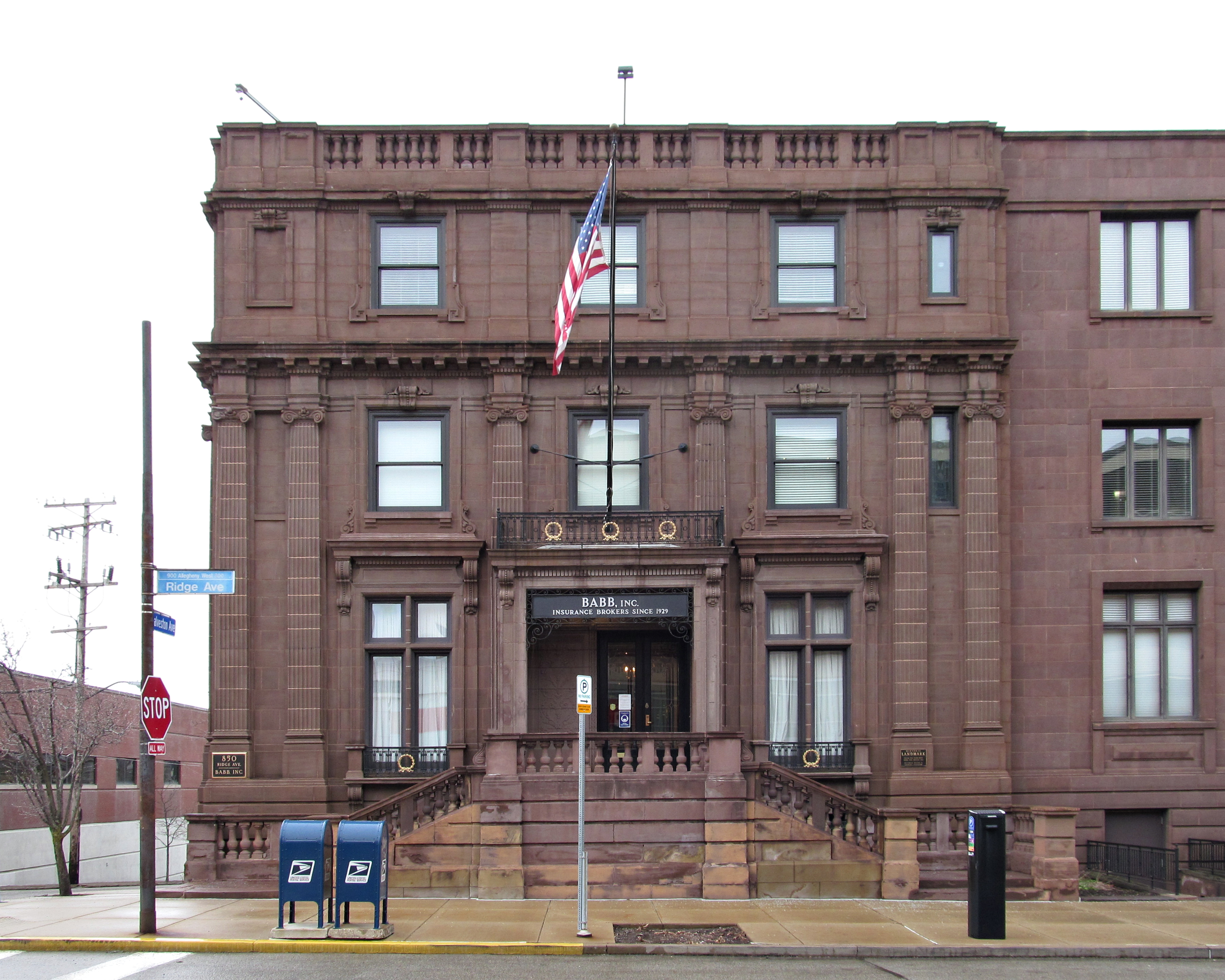
Considering the traditional link between Pittsburgh and New York—the two cities shared millionaires, department stores, and many other cultural phenomena—it’s surprising that this is Pittsburgh’s only New-York-style brownstone palace. The architect was George S. Orth, who was also responsible for the Colonial Place development in Shadyside. The house was built in 1911, shortly before the millionaires began to flee the neighborhood. Since then it has been an office building, and the commercial addition to the right is a good example of how to expand a historic building sensitively without throwing money around like a Pittsburgh millionaire.