Tag: Vittor (Frank)

  • Beechview War Memorials

    Eagle on the World War I memorial

    Beechview keeps four separate war memorials all grouped together in a neat little triangular park at the outer end of the neighborhood: one for World War I, one for World War II, one for Korea and Vietnam, and one peace monument for all wars. The ones for the two World Wars have the names of all the Beechview residents who served; and because large slabs of metal can disappear in the middle of the night, perhaps even in a well-kept neighborhood like Beechview, we have recorded the names in very high resolution.

    First, the World War I memorial:

    World War I memorial
    Names on the World War I memorial

    The picture above is about 50 megapixels, so if you click or tap to enlarge it you should be able to read every name easily.

    Now the World War II memorial:

    World War II memorial

    Old Pa Pitt has not found much information about this memorial so far—even the well-researched Beechview book in the Arcadia Images of America series could only say that it was dedicated at some time in the late 1940s. But if he had to guess, he would say that this looks like a Frank Vittor eagle.

    Eagle on the World War II memorial

    The Second World War was a bigger war, and Beechview was a bigger neighborhood by that time, so all four sides of the monument are covered with names. Again, the pictures are at about 50-megapixel resolution, so all the names will be legible.

    World War II honor roll panel 1
    World War II honor roll panel 2
    World War II honor roll panel 3
    World War II honor roll panel 4
    Fujifilm FinePix HS20EXR; Samsung Galaxy A15 5G.

    Comments
  • World War I Memorial, Braddock

    Victory holding up her wreath

    Frank Vittor was the sculptor of this memorial, in which Victory is striding forward with a laurel crown to honor the people of Braddock who served in the First World War. It was installed in front of the Braddock library in 1923, and from this angle it looks almost brand new.

    World War I memorial
    Base with eagles
    Eagle
    Looking up at the statue of Victory
    Dedication panel

    The base of the monument had six bronze panels with the names of all who served, including this dedication panel with the names of the dead.

    Service roll with names Abt to Dixon

    These pictures are very large, so all the names will be legible if you enlarge the photograph.

    Names Dixon to Hurley
    Missing panel

    We suppose the names between Hurley and Marx were melted down into cheap booze. Old Pa Pitt has always wondered what scrap-metal dealers think when a man in a battered pickup truck rolls up with a big chunk of names in bronze. Apparently they think, “Well, he certainly must have come by this honestly.”

    Names from Marx to Scheig
    Names from Schmidt to Zylinski
    World War I memorial
    Sony Alpha 3000 with 7Artisans f/1.5 35mm lens; Fujifilm FinePix HS20EXR; Samsung Galaxy A15.

    Comments
  • Fifth Ward World War I Memorial, Upper Hill

    Eagle by Frank Vittor

    An unmistakable Frank Vittor eagle; compare it to the eagle on the West End World War I memorial and the one on the portal to the Boulevard of the Allies. City records confirm that Frank Vittor was the sculptor.

    Fifth Ward War Memorial

    The memorial stands in Robert E. Williams Memorial Park, originally Herron Hill Park, which was laid out in 1889. It is a very pleasant green space in a pleasant residential section of the Upper Hill.

    Because war memorials sometimes become illegible for various reasons, and because a historian friend has been trying to reconstruct the names on another World War I memorial and finding the task difficult, old Pa Pitt has decided to record all the names on this memorial. If you enlarge the pictures, you should be able to read every name clearly.

    Inscriptions
    Inscriptions
    Inscriptions
    Inscriptions
    Inscriptions
    Inscriptions

    The emblem of the Corps of Engineers, which in an earlier version of the article Father Pitt had mistaken for the arms of Pittsburgh. Thanks to our commenter below for the correction.

    A map showing the location of the memorial.

  • World War I Memorial, West End Park

    Eagle
    War memorial

    West End Park is far off the beaten track, and few people outside its own neighborhood (which is technically Elliott, though it belongs at least as much to the West End) ever visit, or even know it exists. But it has one of our best war memorials by one of our best sculptors and one of our best architects.

    The sculptor was Frank Vittor, who was already developing the streamlined style that would make him one of Pittsburgh’s two favorite sculptors (the other being Giuseppe Moretti). The architect was William Perry, whose most famous work is St. Bernard’s in Mount Lebanon, a church more magnificent than many cathedrals. Their collaboration produced a striking monument, simple but rich. Unfortunately some restoration has left it with two radically different colors of stone and concrete, which is not how it was meant to look, as we see in this picture from twenty-two years ago:

    Memorial in 2000

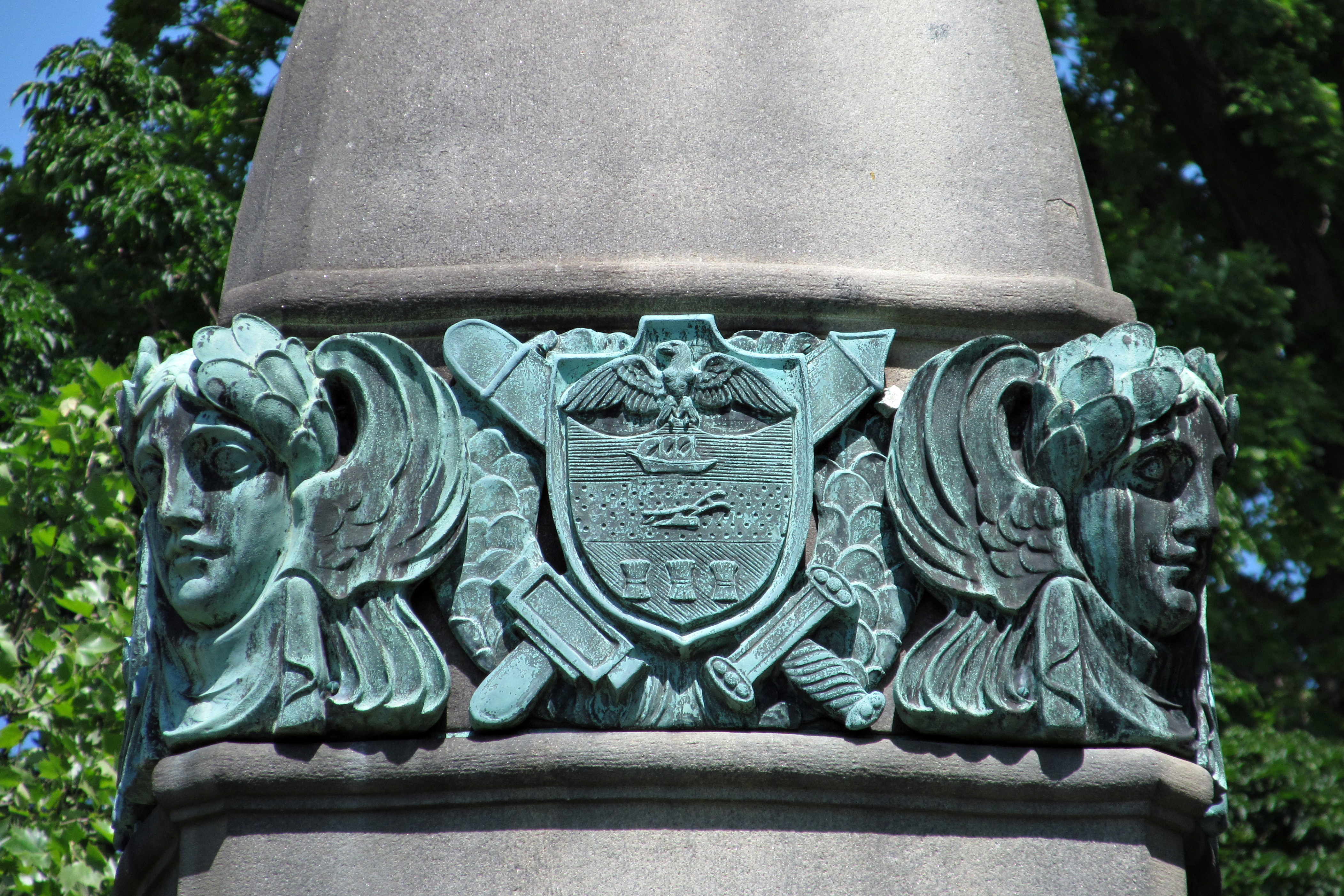
    That picture shows us that the memorial has also lost some sort of bronze ornament on the bottom half of the shaft: we can see the shadow of what seems to have been a shield with double-headed axe set in a bronze band. (Addendum: The book Discovering Pittsburgh’s Sculpture, by Vernon Gay and Marilyn Evert, shows the ornament in place, with a bronze band all the way around the base. That book was published in 1983.)

    Cherubim and shields
  • World War I Memorial, West End Park

    One of the least-known works of Frank Vittor, this memorial sits in the improbably hilly West End Park. It is an ornament to its neighborhood (in spite of some clumsy restoration), and it ought to be better known by Pittsburghers from elsewhere.