The post office in Mount Oliver has been peripatetic if we take a long-term view. It began a few doors north of here on Brownsville Road in a little brick building later replaced by a furniture store. In about 1905, this substantial “flatiron” building went up at the complicated intersection of Brownsville Road, Amanda Street/Avenue (the border between Mount Oliver, which calls it an avenue, and Pittsburgh, which calls it a street), Bausman Street, Sherman Avenue, and Hays Avenue.
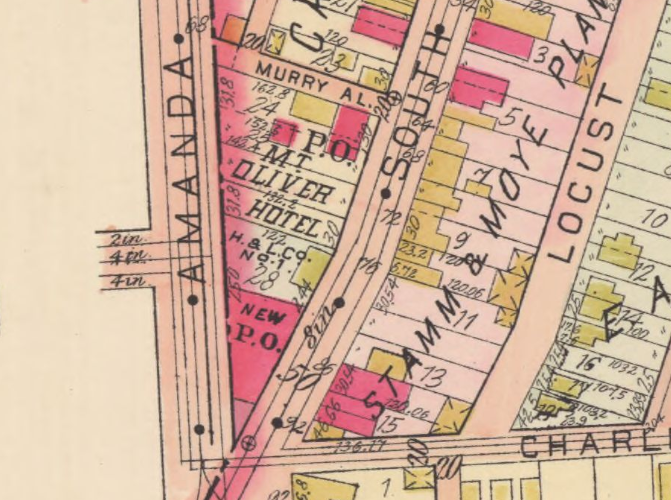
From a 1905 Hopkins plat map. Note the “P. O.” at the corner of Murry Alley, and this triangular building marked as “New P. O.,” suggesting that it was under construction when the map was drawn.
Now the post office is in a much larger modernist building two blocks up Brownsville Road. But this building still stands in reasonably good condition.
William J. Shaw was the architect of the most prominent commercial block in Sheraden, built in 1904 or 1905 for Sheraden’s own self-made developer, contractor, and civic luminary John Murphy.1 The details are mostly Renaissance; but the heavily eyebrowed arches and weighty and elaborate cornice make the term “Rundbogenstil” appropriate, giving us another chance to say the word “Rundbogenstil.”
This is a classic Pittsburgh “flatiron” building, with the classic Pittsburgh problem of three dimensions of irregularity in the lot. To the right the ground slopes precipitously down to the Sheraden station—a railroad station when it was built, a busway station now that the West Busway has duplicated the old Panhandle commuter route to the western suburbs.
We considered taking those utility cables out. After a couple of experiments, we realized it would require more hand-painting than we were willing to do.
A pilaster base on the sharp corner with oversized egg-and-dart ornamentation.
A Renaissance false balcony with egg-and-dart, dentils, and balusterasters in relief. Old Pa Pitt had to invent the term “balusteraster” to describe these false balusters, and now that he has invented it he will use it wherever appropriate. We can see that this building keeps a sharp eye on the complicated and confusing every-which-way intersection outside; possibly the most amusing videos are posted to some YouTube channel.
Pittsburgh Gazette, July 9, 1904, p. 11: “Plans are being prepared by Architect W. J. Shaw for a three-story store and office building to be erected in Railroad street, Sheraden, at a cost of $32,000 by John Murphy.” Also, Philadelphia Real Estate Record & Builders’ Guide, July 27, 1904, p. 481: “Plans have been prepared by Architect W. J. Shaw, Smith Building, for a three-story store and office building to be erected on Railroad street, Sheraden, for Mr. John Murphy, at a cost of $32,000. It will be well finished throughout and provided with the usual modern conveniences.” ↩︎
Built as a branch bank, this tidy little modernistic building seems to be succeeding in its second life as a little neighborhood grocery. It is one of several “flatiron” buildings in Sheraden, and old Pa Pitt had to stand in the middle of a fairly busy intersection to get this picture of the sharp end:
One of several “flatiron” buildings produced by the irregular street layout of Crafton. This one is odd angles all around.
The main entrance is on the sharp corner facing the intersection of Noble Avenue, Crafton Avenue, and Dinsmore Avenue (which is what we meant when we said Crafton had an irregular street layout).
A segmental pediment—that is, a pediment whose top is a segment of a circle, rather than the more usual triangle.
The side entrance would have led into the upstairs offices: a bank putting up a building like this would expect to make extra income from office rentals, and bank buildings were usually prestigious addresses.
The side of the building not meant to be seen is finished more cheaply.
Since we were talking about acute angles, here is a “flatiron” building at the acute angle of the intersection of Main Street and Washington Avenue in Carnegie. Pittsburgh and its surroundings are full of these triangular buildings, because Pittsburgh topography makes it very difficult to lay streets out in a simple grid.
If it isn’t the sharpest, it must at least be close. Father Pitt remembers when the East Wing of the National Gallery of Art was going up in Washington (Big Worshington, that is): it was boasted that I. M. Pei’s design included the most acute angle in any American building. This angle is nearly congruent with Pei’s, except that here the point has been slightly blunted. The architect has made sensible use of that sharp corner by putting the stairwell there, with a column of windows to light it.