

A parade of the largest, though not the tallest, monolithic columns in the world.
Comments
A parade of the largest, though not the tallest, monolithic columns in the world.

Some details of Hampton Hall, a Tudor apartment building in Oakland designed by H. G. Hodgkins.


Views of the roof of Hampton Hall, a large Tudor apartment building in Oakland designed by H. G. Hodgkins. We also have views of the entrance and courtyard, the lobby, and the front and a perspective view.


Hampton Hall is a grand Tudor apartment palace in Oakland designed by the Chicago architect H. G. Hodgkins.

A while ago one of the residents mentioned to old Pa Pitt that the long canopy that usually leads from the courtyard entrance to the street had come down for work, which—our correspondent pointed out—would make some of the previously hidden details accessible to a camera. Here, from about two and a half years ago, is how the canopy usually looks:

And here is the courtyard without the canopy:


Father Pitt ended up spending an hour or more taking pictures all over the building, and since he has so many pictures, he will split them into multiple articles to avoid wearying his visitors. Today we see the courtyard and the main entrance.


As seen from the roof of Hampton Hall. The architect was David J. Vater; the building was put up in 2007.
We also have more pictures from ground level.

This row of seven houses presents a pleasingly varied streetscape, but the houses were clearly all part of the same development. Old Pa Pitt is fairly sure the architects were Rieger & Currier, and for the obsessive historians in the readership, here is his evidence. In the Philadelphia Real Estate Record & Builders’ Guide for February 27, 1901, p. 136, we find this item:
Rieger & Currier, Smith Building, have prepared plans for four brick dwellings to be erected on Ditheridge [sic] street for Mr. J. Friday.
A plat map from about 1903 shows that J. Friday owned land along Dithridge Street on which at least eleven houses, some possibly doubles, were built. Three were on the east side of the street where the Latter Day Saints church is now. The others were on the west side and still stand. Numbers 229–253, part of the Friday property, clearly form a group, and probably the only group in which four houses could have been built together at one time. If we assume that they were built in one group of three and one group of four, these are all Rieger & Currier houses.

The houses have been divided into apartments, and a couple of them have had porch amputations or reductions, but on the whole the look of the row is well preserved.


And now a bonus house, just past the Friday row, a fine center-hall house in the free turn-of-the-twentieth-century version of Georgian.


David J. Vater designed this distinctive Gothic building, built in 2007 from modern materials in a style we might call “postmodern Gothic.” It’s the home of the National Institute for Newman Studies, one of those fascinating cultural treasures few Pittsburghers even know about. The Institute is devoted to the study of the works and teachings of John Henry Newman (1801–1890), an English convert to Roman Catholicism who rose to become a cardinal in the Catholic Church. In 2019, Newman was canonized as a Catholic saint, and just three months ago (on November 1, 2025) he was declared a Doctor of the Church, one of only 38 people so far whose teachings are regarded as so extraordinarily important that they merit that title.


The arms of Cardinal Newman, with his motto: Cor ad cor loquitur—“Heart speaks to heart.”

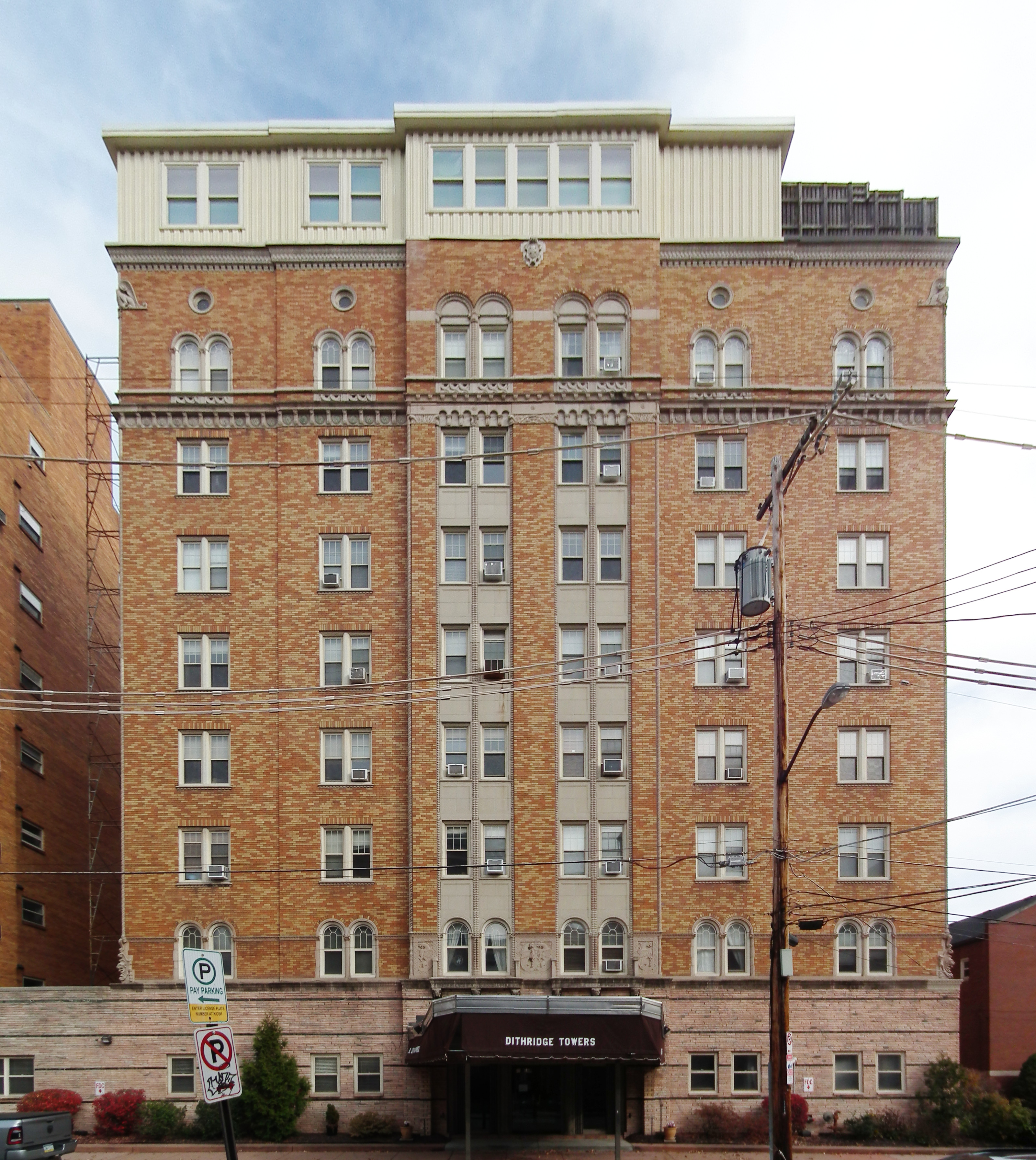
Built in 1929, this eight-storey apartment tower has a newer ninth floor sheathed in what appears to be corrugated metal. Father Pitt has some advice for architects contemplating asymmetrical additions with cheap materials to symmetrical Renaissance palaces like this:

Like several other apartment buildings in the area, this one is festooned with grotesque whimsies.


The rear section has a bay rising the entire height of the building, with a corrugated-metal hat on top.
Addendum: A kind correspondent has found an advertisement for the Dithridge Apartments when they were new, which supplies us with a definite date (1929; they were to be ready for occupancy in April) and shows us the building as it looked before the top was altered.
