Murdoch Farms is the plan in Squirrel Hill famous for millionaires’ mansions, but this is the middle-class corner of it. The houses here were also designed by some of our prominent architects, but on a more modest scale. We haven’t identified most of them yet, but we’ll point out the architects we know.
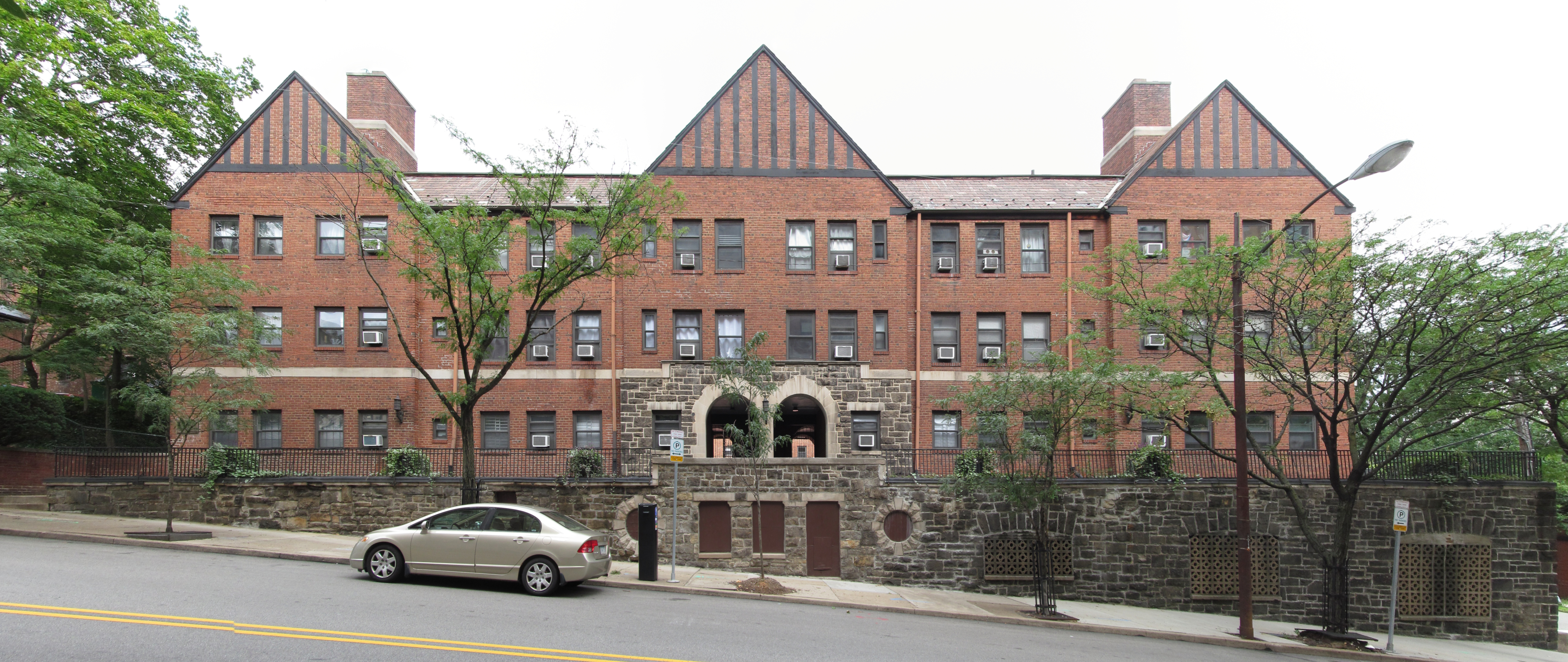
The apartment building above, which faces Centre Avenue, is arranged as a kind of Tudor Renaissance palace. In defiance of its sloping site, it is a perfect rectangle arranged around an open courtyard. One can imagine Queen Elizabeth building herself a palace on this pattern.
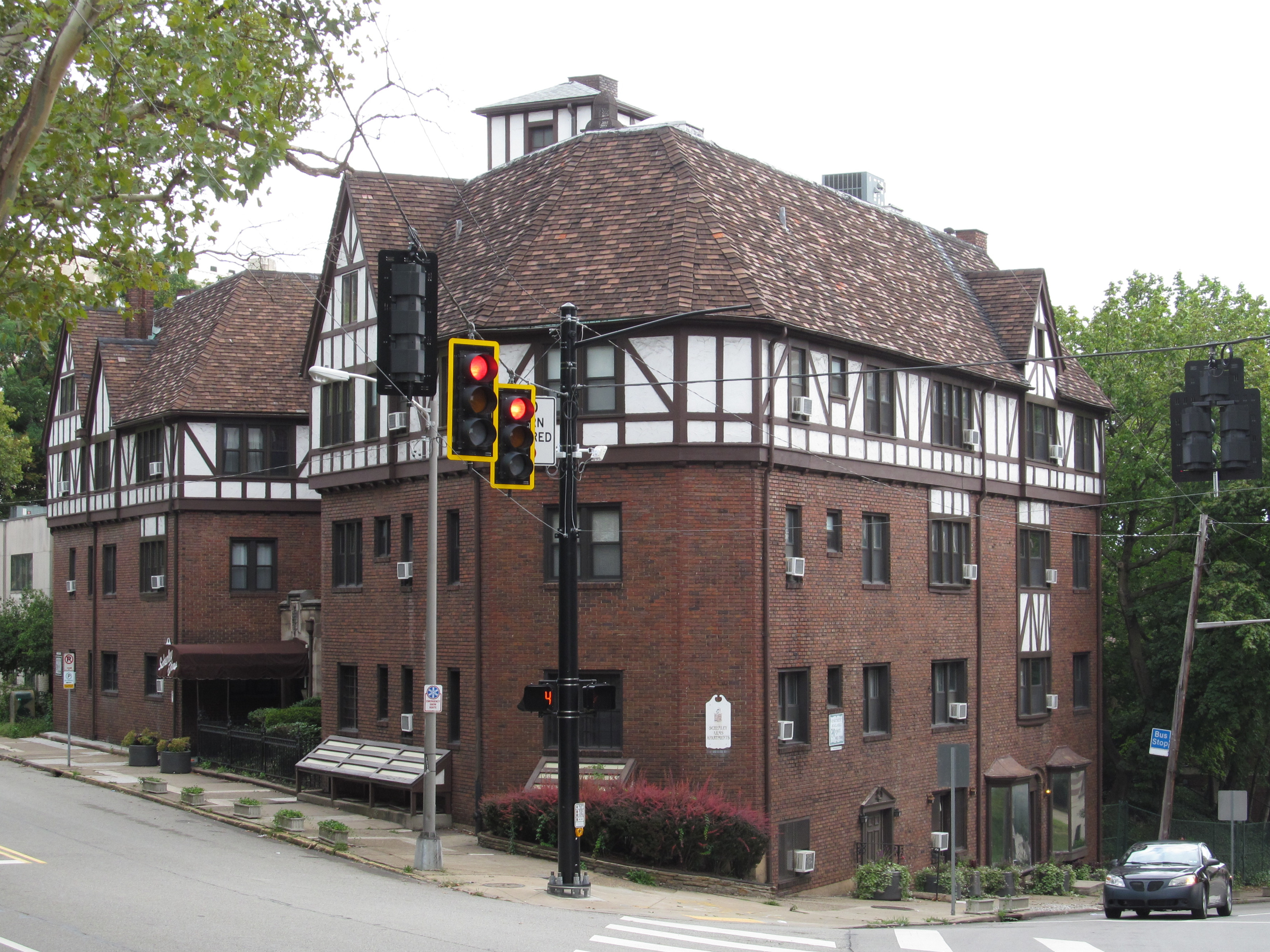
Almost adjacent—in fact, directly adjacent in the rear parts—is the Schenley Arms, which sits in the narrow angle between Centre Avenue and Bigelow Boulevard.
Where the (unnamed, at least on its face) apartment building above is in the style of a Tudor palace, this is deliberately arranged in the ramshackle fashion of an old English inn. The deliberately haphazard shape takes advantage of a very irregular lot and gives the building an entirely different appearance from different angles.
Neither one of these buildings is a very accurate representation of real Tudor architecture: they are mostly put together from standard parts with Tudor accents added. But the Tudor accents are valuable. Especially in the Schenley Arms, they give the building an architectural reason for being an absurd mishmash of odd angles: it looks as though the building was supposed to be that way, rather than forced into its absurd shape by the constraints of an absurd property.
Update: Note the comment below identifying Edward Crump, Jr., as having designed and built the Schenley Arms. The other building, which was named the Pennsylvanian, was designed, constructed, financed, and managed by architect Daniel A. Crone, according to his biography in Pittsburgh of Today (1931).