Tag: Civil War

  • Civil War Monument in West Park, North Side

    Civil War Monument

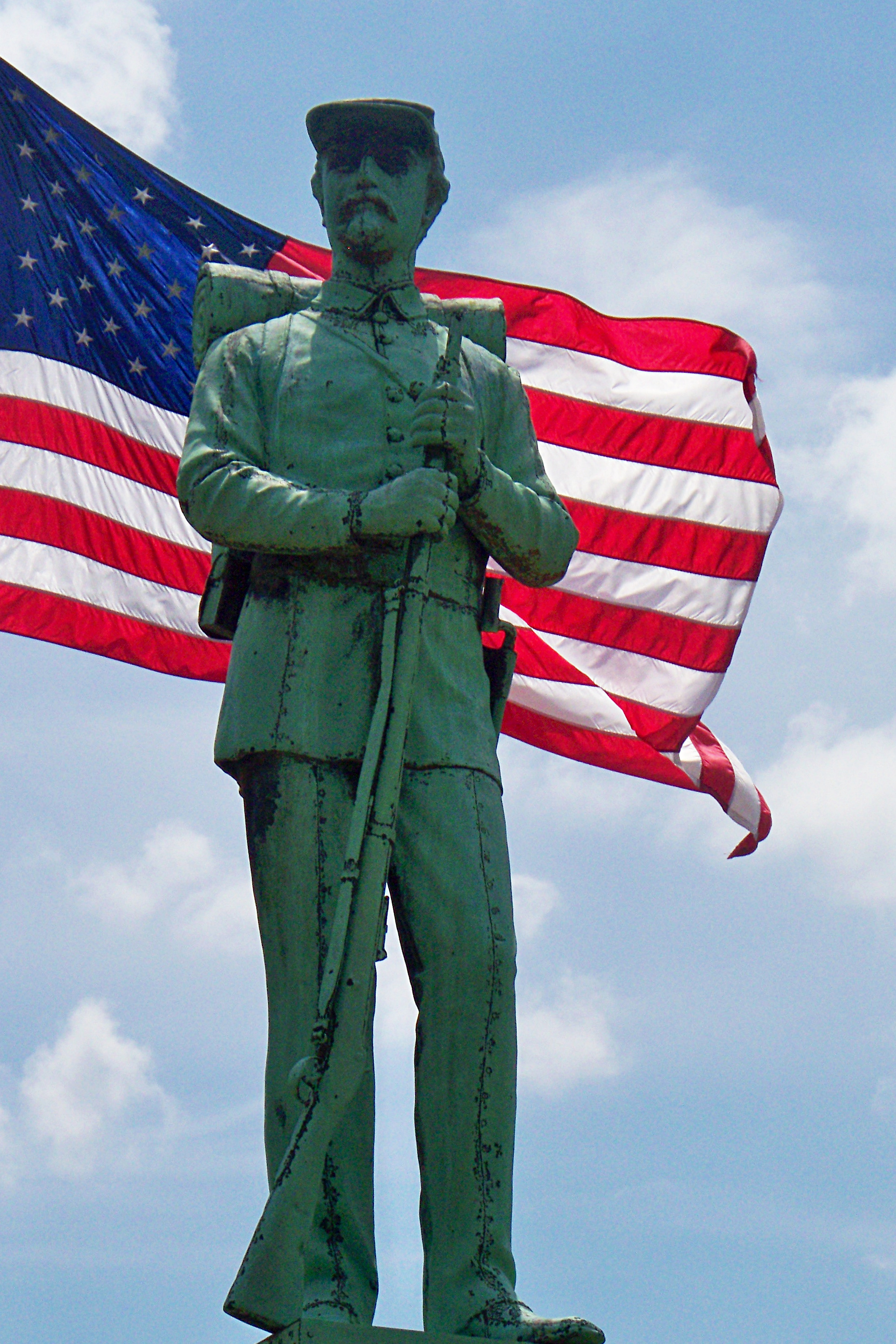
    The Civil War monument was a grand and expensive construction on Monument Hill—which was named for it—dedicated in 1871. Today Monument Hill is covered with buildings of the Community College of Allegheny County; the monument was moved to its present location in 1931, where it looks over Lake Elizabeth in West Park. When it was moved, it was substantially redesigned, but many parts of the old monument were incorporated in the new one.

    Shaft with golden Ginkgo biloba leaves

    This part of the shaft, for example, which is now near the base, was the whole column of the original monument, as we see in this old postcard:

    Postcard of the original Civil War monument
    Statue of Fame

    The statue of Fame on top of the monument was damaged by a lightning strike in 2008; the repaired monument was rededicated in 2016.

    Top of the monument
    Base of the monument
    Eagle on the base

    An eagle examines us from behind the Allegheny County arms.

    Eagle
    Base of the monument
    Inscription
    Canon PowerShot SX20 IS.

    The left half of the inscription: “Erected to the memory of the 4,000 brave men of Allegheny County who fell in the great struggle to maintain the integrity of our Union. The eye of God rests upon their graves even when unmarked by man, and their sleeping dust shall arise in the morning of the resurrection.”

    The right half is taken from the end of Abraham Lincoln’s second inaugural address: “With malice towards none, with charity for all, with firmness in the right, as God gives us to see the right, let us finish the work we are in to bind up the nation’s wounds, to care for him who shall have borne the battle and for his widow and his orphans, to do all which may achieve and cherish a just and lasting peace among ourselves and with all nations.”


    Comments
  • Allegheny Arsenal Powder Magazine, Lawrenceville

    Allegheny Arsenal Powder Magazine

    Benjamin Henry Latrobe, much more famous for his work on the United States Capitol, was Pittsburgh’s first resident professional architect. This is his only remaining work here, and the only original 1814 building left from the Allegheny Arsenal.

    Insignia

    This plaque was originally on the gatehouse to the Arsenal grounds.

    Daughters of 1812 memorial

    A memorial put up by the Daughters of 1812 appears to have had a bronze relief, probably stolen many years ago.

    Daughters of 1812 plaque

    The Arsenal is most famous in history for exploding during the Civil War, killing dozens of the workers, many of whom were children. We note that the building where the powder was stored did not explode—an indication, perhaps, that the architect knew his business.

    Plaque on the powder magazine

    DESIGNED BY BENJAMIN H. LATROBE; BUILT BY CAPTAIN ABRAM R. WOOLLEY ON LAND PURCHASED BY THE FEDERAL GOVERNMENT FROM WILLIAM B. FOSTER. SERVED AS AMMUNITION PRODUCTION CENTER DURING INDIAN, MEXICAN AND CIVIL WARS. THIS TABLET COMMEMORATES AT LEAST 79 CIVILIAN WORKERS—MEN, WOMEN AND MANY CHILDREN—KILLED IN THREE MYSTERIOUS EXPLOSIONS, SEPTEMBER 17, 1862.

    Old Pa Pitt would add that the explosions were not as mysterious as all that. It was an arsenal. The place was devoted to manufacturing things that explode, using explosive materials. Everyone knew that Dupont & Co. had been supplying powder in leaky barrels, probably reused in spite of the specific requirement not to reuse them. Everyone knew there was explosive stuff dusting the ground here and there. The only mystery was which of several possible causes set off the first spark, and that mystery will probably never be solved.

    The remains of the dead were buried in a mass grave in Allegheny Cemetery, where an expensive marble memorial was put up. The marble eroded into illegibility by the 1920s, and it was replaced with a new monument with a bronze plaque that will last a few more centuries if it is not stolen and melted down.

    Names of the dead in the Arsenal explosion
    Allegheny Arsenal monument in Allegheny Cemetery

    Today the powder magazine sits in the middle of a pleasant urban oasis called Arsenal Park. Instead of explosive materials, it has rest rooms.

    Allegheny Arsenal Powder Magazine
    Powder magazine
    Powder magazine with 40th Street in the background
    Kodak EasyShare Z1285; Fujifilm FinePix HS10; Kodak EasyShare Z981.
  • Post Office, by David Gilmour Blythe

    Post Office, by David Gilmour Blythe

    This is probably David Gilmour Blythe’s masterpiece, although old Pa Pitt would certainly listen to arguments in favor of The Coal Carrier. It has all the comical details you expect from one of his larger paintings, perfectly executed and worked into an overall composition that is also just about perfect. And yet there is perhaps a whiff of tragedy in the midst of the comedy: this was probably painted during the Civil War (Blythe didn’t date most of his paintings, so we’re just guessing), when you would have seen a crush at the General Delivery window every time the mail came in, because hundreds of people were waiting to hear whether their sons and brothers and husbands were still alive.

    The strange power of Blythe is that he paints humanity at its worst, and yet we come away thinking that humanity is worth saving after all.

  • Remembering Those Who Served in the Civil War

    The Civil War monument in Richland Cemetery, Dravosburg. The sculpture bears a maker’s plaque: “Manufactured by the W. H. Mullins Co., Salem, Ohio, U.S.A.”

    Camera: Kodak EasyShare Z1485 IS.