Tag: Hodgdon (Chauncey W.)

  • Zion Evangelical Church, Bloomfield

    Zion Evangelical Church

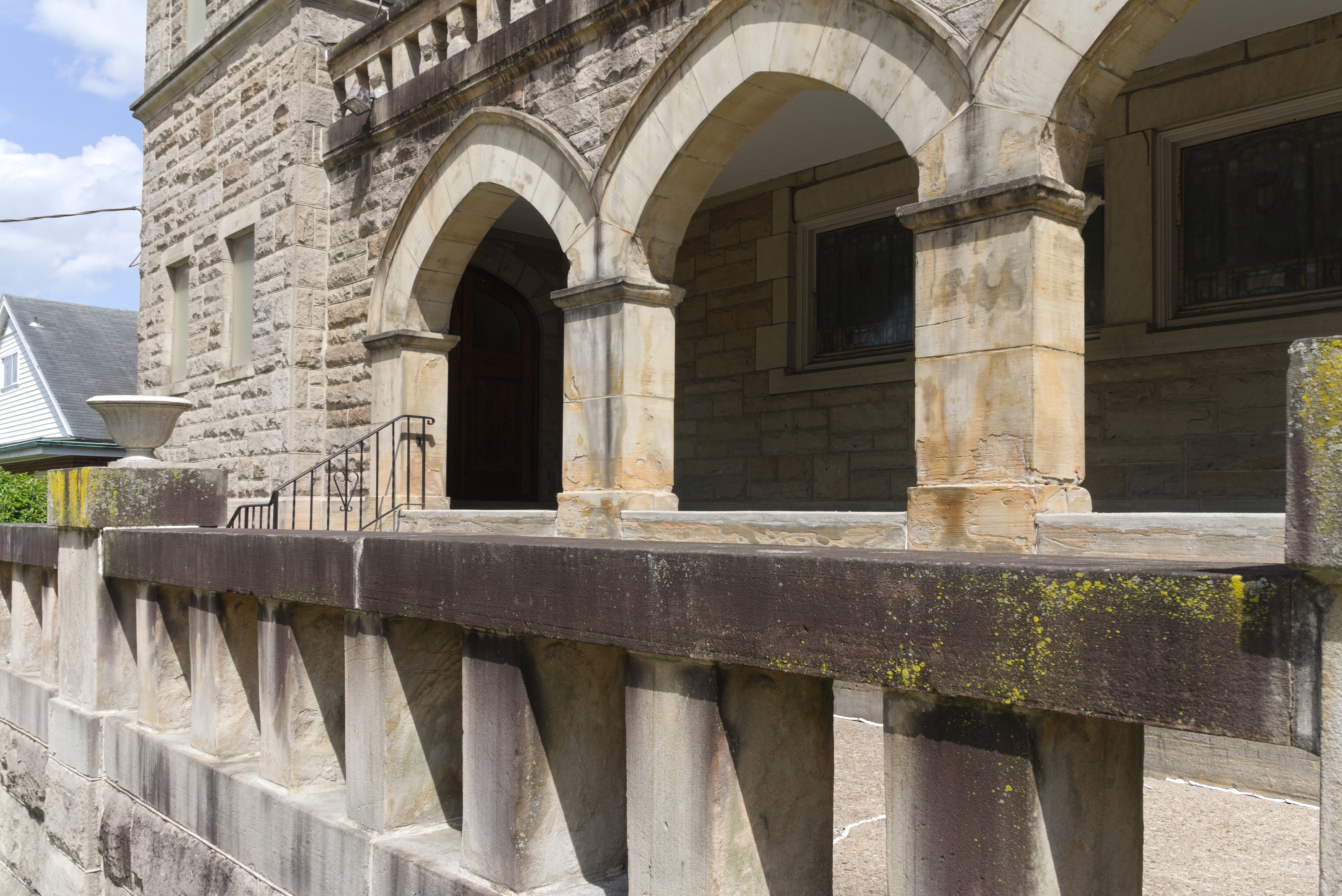
    If you are looking for a distinguished church building, here is one for sale, and in very good shape. It was built in 1906 as Zion Evangelical Church; the architect was Chauncey W. Hodgdon.1 For many years it was the Albright Methodist Church.

    Front elevation

    The building had more than one narrow escape from death. It was owned by the Methodists who also had the cathedral-sized First United Methodist Church right next to it; since this church was redundant, they proposed to sell it to a developer who would demolish it and build something profitable. When a city historic designation made that more difficult, the church sat abandoned and decaying for several more years, exchanging the fast death of redevelopment for the slow death of neglect. But about three years ago it was restored, including cleaning off the decades of accumulated soot.
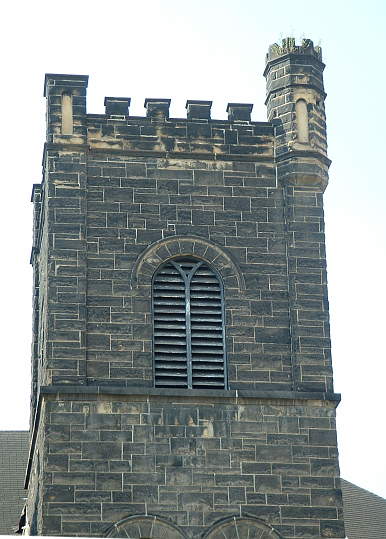
    Tower in 2008, when it was black

    This was the tower when old Pa Pitt passed by in 2008; he published this picture under the heading “The Vanishing Black Stones of Pittsburgh.” We may add this building to the list of previously black buildings whose blackness has vanished.

    Tower cleaned

    Or at least mostly vanished.

    Tower and entrance
    Entrance
    Wing with turret

    In the background we can see the massive lantern of First Methodist.

    Perspective view
    Graham Street side
    Graham Street side
    Canon PowerShotSX20 IS; Sony Alpha 3000 with 7Artisans f/1.4 35mm lens.
    1. According to a city architectural survey from a few years ago. “This now-closed church has been for sale for several years now in an area where development pressures are significant. There was a fight in 2016 over possible city designation as historic, which was granted. The register had the address as 5445 Centre Ave. but the legal address is 486 S. Graham St.” ↩︎

    Comments
  • Ingomar Methodist Episcopal Church

    Ingomar Methodist Episcopal Church

    This is an old congregation, founded in 1837, and its adjoining cemetery has some stones dating from shortly after that. It has grown continuously; the building you see here was designed by Chauncey W. Hodgdon and built in 1915, and encrusted with additions fore and aft in later years. But the congregation (still Methodist, but advertising itself these days just as “Ingomar Church”) outgrew this church and built a much bigger one across the street; this is now the Ingomar Church Community Life Center.

    Front of the church

    The 1915 church was originally built very cheaply; its final cost of about $9,000 was roughly equivalent to the price of two middle-class houses at the time. A good history of the church was written in 1962 by Margaret L. Sweeney, and we take our information from that booklet (but we have corrected the spelling of the architect’s name).

    Steeple
    Ingomar Church Community Life Center
    Ingomar M. E. Church
    Rear of the church
    Ingomar Church, new building
    Kodak EasyShare Z1285; Fujifilm FinePix HS10.

    The new building across the street is in a grandiose New Classical style that recalls colonial New England churches and refracts them through a Postmodernist lens.

    Ingomar is an unincorporated community that straddles two municipalities. Most of the church grounds and the cemetery are in the borough of Franklin Park, but the border with McCandless Township runs diagonally through this building.

  • Neville Island Presbyterian Church

    Neville Island Presbyterian Church

    This article has been rewritten from its original version, which said that Father Pitt knew nothing about the church. After that, information trickled in.

    This church was built in 1916 or so; the architect was Chauncey W. Hodgdon.1 The congregation informed the Presbytery that it would close the church in 2022, according to a Pittsburgh Presbytery newsletter [PDF], but the grounds are still mowed and the building is in good shape. Its most prominent feature is its tower with eye-catchingly prickly battlements.

    Neville Island Presbyterian Church
    Oblique view of the front of the church
    Kodak EasyShare Z1285.
    1. Source: American Contractor, March 11, 1916, p. 53. “Church: $20,000. 1 sty. & bas. 60×80. Neville Island. Archt. Chauncey Hodgdon, Penn building. Owner Neville Island Presby. Church, Dr. Wm. P. Shrom Thorn, Run rd. Plans in progress. Will take bids soon. Brk. veneer on hollow tile.” ↩︎
  • Oakmont Methodist Episcopal Church

    Oakmont Methodist Episcopal Church

    Perhaps a member of the congregation can help sort out the history of these two church buildings in Oakmont.

    Just this first one, which is still a United Methodist church, is complicated enough. It appears from construction listings to have been started under one architect and finished under another. The current form of the church is the work of Pittsburgh’s Chauncey W. Hodgdon, who drew the plans in 1914. That arcaded porch is a typical Hodgdon feature.

    The Construction Record, September 12, 1914: “Oakmont, Pa.—Architect C. W . Hodgdon, Penn building, Pittsburgh, has new plans for the superstructure of a one-story stone church for the First Methodist Episcopal Congregation on Fifth and Maryland street to be built at a cost of $30,000.”

    Porch
    Porch

    But the construction listings tell us that Hodgdon was responsible for the “superstructure”: apparently the foundations had been laid already under the supervision of the prolific New Castle architect William G. Eckles.

    The American Contractor, January 25, 1913: “Church: 1 sty. $30,000. Oakmont, Pa. Archt. Wm. G. Eckles, Lawrence Savings & Trust bldg., New Castle. Owner M. E. Church, Oakmont. Plans in progress; architect will be ready for bids March 1. Brick, stone trim, wood cornice, struct. iron, hardwood finish & floors, gas & electric fixtures.”

    Mr. Eckles was a successful and reliable architect who littered Western Pennsylvania with fine schools and churches, so old Pa Pitt has no explanation for why he did not finish this project. We note also that the budget seems to have gone up: under Eckles, it was to have been a brick church with stone and wood accents at $30,000; Hodgdon’s “superstructure” was budgeted at $30,000, which we presume did not include the foundations, and it was all stone.

    Around the corner is an older church whose date stone tells us it was the previous Oakmont Methodist Episcopal Church:

    [Older Oakmont M. E. Church

    Date Stone: Oakmont M. E. Church, 1892.

    This is also a slight mystery, because the date stone says 1892, but the building bears a plaque that says “Circa 1877.” (Many buildings in Oakmont bear date plaques, all with “circa,” probably under the common assumption that “circa” means “here comes a date.”) Father Pitt’s guess is that the tower was built after the church. The building is no longer a church: it is now something called “The High Spire.”

    Entrance
    Old Oakmont M. E. Church

    Cameras: Sony Alpha 3000; Nikon COOLPIX P100.

  • Calvary Christian Church, Marshall-Shadeland

    Calvary Christian Church, Marshall-Shadeland

    Chauncey W. Hodgdon had been practicing architecture for well over four decades when he designed this little church. It was built in about 1924,1 and this is Hodgdon on a small budget. He minimized expensive indulgences like stone trim and large windows, while still giving the congregation the respectable Gothic church it dreamed of. Now the building belongs to New Hope Church, which is keeping it in very good shape.

    New Hope Church
    1. Source: The American Contractor, August 11, 1923: “Church: Shadland [sic] av. & Dickson st. Archt. Chauncey W. Hodgdon, Martin bldg. Owner The Calvary Christ. Church. Rev. F. Fink, 3426 Cass st. Brk. & Stone. Archt. taking bids on super. to close Aug. 20.” ↩︎
  • St. Luke’s English Evangelical Lutheran Church, Lafayette Hilltop

    St. Luke’s Evangelical English Lutheran Church

    This fine building, put up in 1912, is well preserved but unused, and we hope it can be kept in good shape. It sits in the Perry Hilltop part of Lafayette Hilltop—“Perry South” on city planning maps. It was designed by Chauncey W. Hodgdon1 in an interesting combination of styles—round arches for the smaller windows, broad Gothic arches for the large windows, and a Tudor Gothic arcade in the front; except that the arches are more rounded than usual Tudor arches. Perhaps an architectural historian can nail down the style precisely, or perhaps it is simply unique to Hodgdon.

    Arcade
    Front
    Date stone

    The Allegheny City Society has a substantial article about this church in the spring 2017 issue of the society newsletter (PDF).

    With a utility pole
    1. In an earlier version of this article, we were not sure whether his given name was Chancey or Chauncey, but Chancey was a misprint that propagated to some later sources. ↩︎
  • First Ruthenian Church, South Side

    First Ruthenian Church

    This church was built as the First Ruthenian Church (a Presbyterian church for Ruthenian immigrants), and later became a Byzantine Rite church. Now, like many other things on the South Side, it’s a bar.

    Addendum: The architect was Chauncey W. Hodgdon, whose churches were usually in the Gothic style, but who adopted a mixture of classical and Byzantine for this very unusual congregation.1

    1. Source: “More Work for Builders Made by the Architects,” Pittsburgh Daily Post, September 15, 1912, p. 36: “Bids will close early in the week on the erection of a one-story brick and stone church building, to be built on the Southside for the Ruthenian Church, of the Presbytery of Pittsburgh. Architect C. W. Hodgdon prepared the plans for the structure, which will be 32×66 feet, costing $25,000.” ↩︎