

This is the newest of the three-building complex: the original King Edward Apartments, the King Edward Annex, and this King Edward, built in 1930. Walter Perry of Chicago was the architect of this palatial addition to John McSorley’s empire of apartment buildings. It was front-page news on and off when it was new, and not in a good way: some miscalculation in the surveying seems to have ended with a few inches of this building encroaching on the property to the left. That property owner was a cantankerous and litigious sort who refused all McSorley’s offers for the land; it seems he was hoping for a big payout if he went to court. To forestall the lawsuit, McSorley had a crew start chiseling several inches of brick off the end of the building—but then the property owner claimed he was trespassing and got an injunction to stop the work.
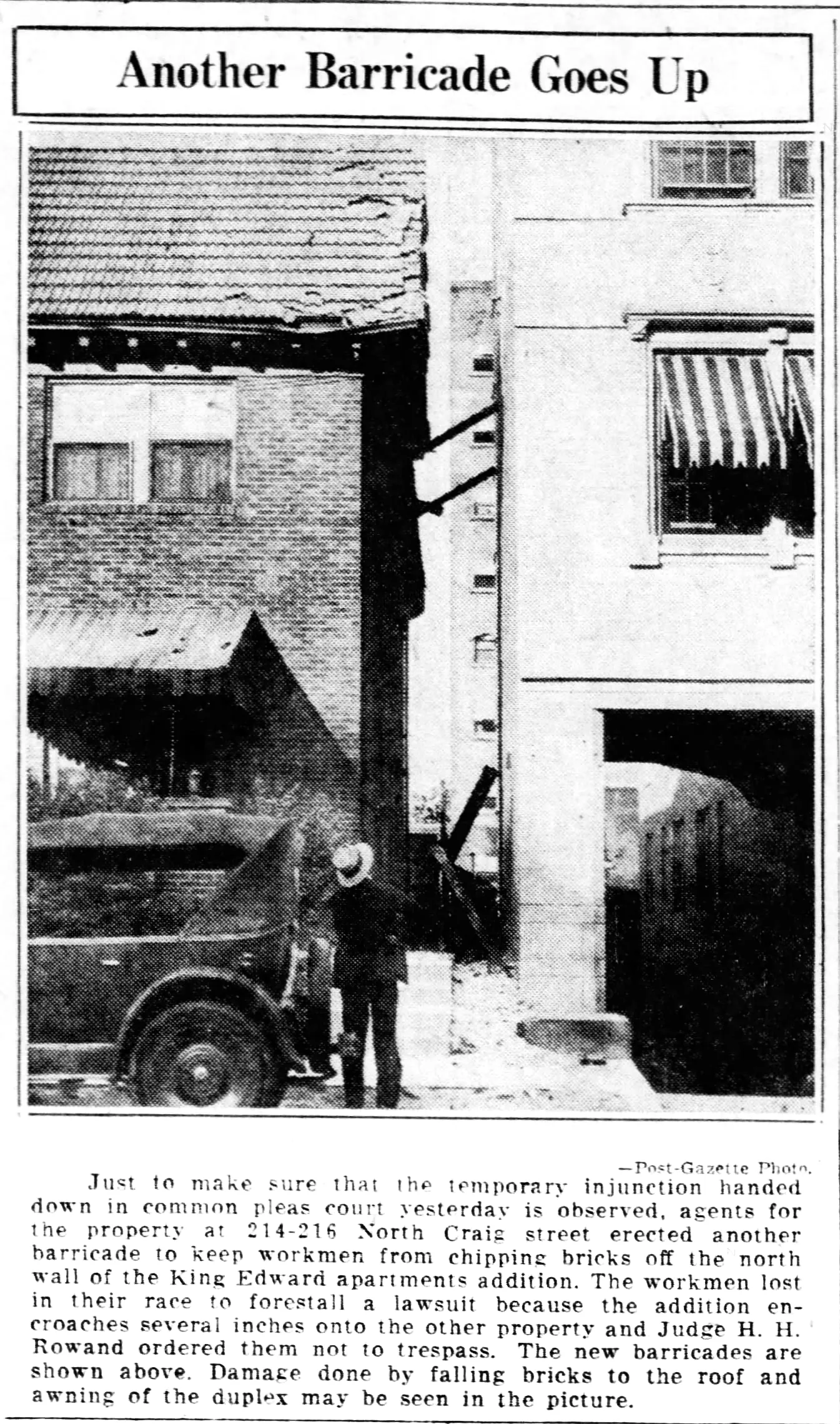
Just to make sure that the temporary injunction handed down in common pleas court yesterday is observed, agents for the property at 214-216 North Craig street erected another barricade to keep workmen from chipping bricks off the north wall of the King Edward apartments addition. The workmen lost in their race to forestall a lawsuit because the addition encroaches several inches onto the other property and Judge H. H. Rowand ordered them not to trespass. The new barricades are shown above. Damage done by falling bricks to the roof and awning of the duplex may be seen in the picture.


