Father Pitt

Tag: Arch Street

  • St. Peter’s Church, North Side

    St. Peter’s, perspective view

    On a rainy evening not long ago, old Pa Pitt stopped to take a few pictures of the former cathedral of the former diocese of the former city of Allegheny.

    Saint Peter Catholic Church, former cathedral of the former diocese of Allegheny, sign

    He took a few pictures of a few details, and then the windows of heaven were opened and a drenching downpour sent him scurrying for shelter.

    Main entrance

    Andrew Peebles, one of our most important architects in the latter 1800s, designed this fine example of mid-Victorian Gothic, which was built in 1872–1874. It was a cathedral-sized church; so when, shortly after it was finished, Bishop Domenec threw Catholic Pittsburgh for a loop by coming back from Rome with the news that there was a new diocese of Allegheny, this church was ready to slip comfortably into its new role.

    The new diocese, however, was a flop. Allegheny had all the rich churches; Pittsburgh had all the debt. Bickering followed, until the Pope, declaring that you kids should just settle down and let a body think for a while, suppressed the diocese of Allegheny in 1889, and Pittsburgh absorbed the territory again. In the secular world, the city of Pittsburgh would soon absorb the city of Allegheny itself.

    Left entrance

    But a diocese never really goes away in the Catholic Church, and there is still a titular bishop of Allegheny, who the last Father Pitt heard was an auxiliary bishop of Newark. And a church never forgets that it has been a cathedral.

    Iron fence in front of the church

    This fine iron fence bears the mark of its makers: Cochran Bros. of Pittsburgh.

    Makers’ mark: Cochran Bros., Pitts., Pa.
    Iron fence
    Fujifilm FinePix HS20EXR.

    And then the rain came. But we have more pictures of St. Peter’s, as well as some pictures of St. Peter’s at night.

    It’s worth noting that the cathedral was hit by a disastrous fire in 1886 that destroyed everything but the walls. But the original plans were followed in the reconstruction, and Peebles was still around to supervise, so the current church is essentially the one that was built in the 1870s.


    Comments
  • Arch Street, North Side

    Arch Street

    Arch Street, which is now included in the Mexican War Streets despite not bearing the name of a battle or a general, is a typical North Side combination of dense rowhouses, small apartment buildings, and backstreet stores. Here are just a few sights within one block of the street.

    1225 Arch Street

    An exceptionally elaborate Queen Anne house whose owner has used bright but well-chosen colors to emphasize the wealth of detail on the front.

    1300 and 1228

    Two modest houses from before the Civil War; the brick house at left is dated 1842.

    1301 Arch Street

    A small apartment building with a well-balanced classical front.

    1301
    Front door

    Some fine woodwork surrounds a front door.

    1320

    The colorful dormer steals the show, but enlarge the picture to appreciate the terra-cotta grotesques on the cornice.

    1322

    This little building looks as though it dates from the 1920s. Although it is quite different in style from its neighbors, it fits harmoniously by sharing the same setback and similar height.

    1327

    A backstreet grocery that is currently functioning as a backstreet grocery—an unusual phenomenon in city neighborhoods these days. The apartment building above it has some interesting and attractive brickwork.

    1327
    Sony Alpha 3000.

    Comments
  • A Big Man’s Tiny House

    George Ferris House
    Sony Alpha 3000.

    This tiny house on Arch Street, which is now part of the Mexican War Streets Historic District, is one of the less distinguished houses from an architectural point of view. Crammed into a half-size lot beside a much larger house, it has nothing but a little plaque on the front to tell you that a great man once lived here. This was the home of George Washington Gale Ferris, Jr., when he invented the Ferris wheel.

    The great wheel was conceived as an answer to the Eiffel Tower. The Exposition Universelle in Paris had attracted the admiration of the world with the world’s tallest structure. Chicago was planning the World’s Columbian Exposition: what could possibly outdo the Eiffel Tower? George Ferris, until then a moderately successful engineer in Pittsburgh, designed the great wheel, and it was a success.

    The original Ferris Wheel

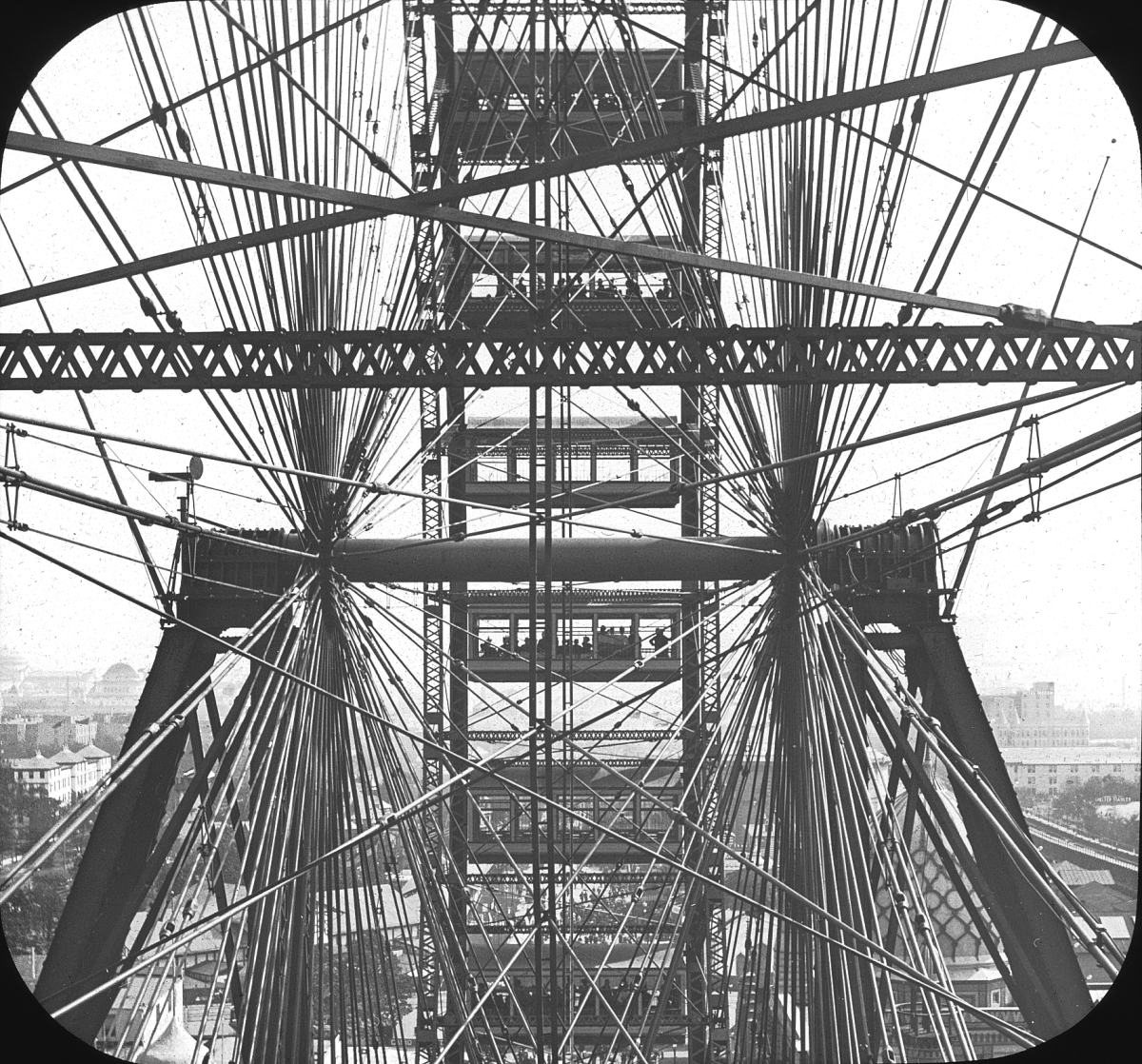
    A few numbers will show what a colossal construction this was. It had 36 cars. Each car had 40 seats, with room for 20 more people standing. Altogether, more than two thousand people could ride the Ferris Wheel at once.

    View through the Ferris Wheel
    View from one gondola to the gondolas on the other side of the wheel. Note the relative size of the people in the cars. (From the collection of the Brooklyn Museum.)

    The Lumiere Brothers, pioneer moviemakers, captured the wheel in motion in 1896.

    George Ferris never made much money from his great wheel; in fact he believed that the fair promoters had cheated him out of his share of the profits. In November of 1896, just three and a half years after the fair opened, Ferris died of typhoid fever. He never got rich enough to move out of this tiny house on Arch Street.