At least fifteen churches were destroyed to make way for the redevelopment of Allegheny Center. It was one of the most audacious applications of the ideas of Le Corbusier ever attempted: an entire city center destroyed and rebuilt to modern taste, with only a few isolated landmarks left as museum pieces. The fact that only one of them (St. Peter’s) was a church may tell us something about the assumptions of twentieth-century urban planners.
Oddly, this building, which originally belonged to the First United Presbyterian Church of Allegheny, was one of the few buildings the demolishers left, even though the church next to it was destroyed. It was built in 1916; the architect was R. Maurice Trimble. It now belongs to the Allegheny Center Alliance Church.
The parapet with a rounded crest at the top of the building is a favorite Trimble detail; we see a similar treatment, for example, on the Allegheny YMCA, built ten years later.
Smithmeyer & Pelz designed Andrew Carnegie’s first library donation—though, as the people of Braddock are proud to point out, it was the second Carnegie Library to open, since the smaller Braddock library took less time to build. The same architects had designed the Library of Congress, which turned into a quagmire from which they had a hard time extricating their careers intact. (The library part was a piece of cake; it was the Congress part that was impossible to manage.) Unlike the classical Washington library, though, this one was done in a Romanesque style, which architects seem to have instinctively hit on as more suitable for muscular industrial Pittsburgh.
After the library was damaged by a lightning strike, the Carnegie Library moved out and built a smaller branch library northward on Federal Street. This building now is the Museum Lab of the Children’s Museum.
This very Miesian building was designed in Ludwig Mies van der Rohe’s firm after Mr. Mies had died, which, as old Pa Pitt has said before, explains how the architect, Bruno P. Conterato, got away with making it a white box on stilts instead of a black box on stilts. Since IBM left, it has been known as Four Allegheny Center.
The Buhl Planetarium and Institute of Popular Science was the big science museum on the North Side before it merged with the Carnegie and moved into the Science Center.
For a while the Art Deco classical building, designed by Ingham & Boyd (or Ingham, Boyd & Pratt; Father Pitt is not sure when Pratt came into the partnership) was sparsely used for classes and other activities, but after the Carnegie moved everything into the Science Center, the Children’s Museum took over the building for a huge expansion.
The Carnegie Free Library of Allegheny, Andrew Carnegie’s first donation (and the second one to open, after Braddock), set the pattern for many of the larger libraries to come: it included not only a library but also a music hall, so that the building gave the people of the city a palace of culture. This is the first Carnegie Hall ever: the one in Braddock was a later addition to the library. The architects of this building were Smithmeyer & Pelz, who had earned their library-drawing credentials by winning the competition to design the Library of Congress. First Smithmeyer and then Pelz would later be thrown off the Library of Congress job, because it’s hard to work on a huge government project that’s eagerly watched by every newspaper in the nation and supervised by the entire United States Congress. They probably found it much easier to deal with Mr. Carnegie. Nevertheless, all Mr. Carnegie’s other libraries in Pittsburgh were designed by Longfellow, Alden & Harlow, or just Alden & Harlow, who became his preferred firm and knew exactly what he wanted.
The music hall is now in use as the Hazlett Theater.
The main library was damaged years ago by a lightning strike, which provoked the library to move out to a new building on Federal Street; but the Children‘s Museum has taken over and restored this historic building and uses it as the Museum Lab.
The Allegheny Post Office was built in 1897 under the reign of William Martin Aiken as Supervising Architect of the United States Treasury. In 1967, the post office moved out, and the building was scheduled for demolition to complete the modernist paradise of Allegheny Center. However, the Pittsburgh History and Landmarks Foundation scraped up the money and rescued it, using it as a Landmarks Museum for a while. Later, when the PHLF moved to Station Square, the building became the Children’s Museum of Pittsburgh, which has since gradually expanded to take over all three of the historic buildings left from the old center of Allegheny—the Post Office, Buhl Planetarium, and the Carnegie Free Library.
“Blue-hour” pictures are very fashionable these days. Old Pa Pitt can do them, too, but only a few at a time, because twilight refuses to stand still and have its picture taken for hours on end.
When the new Post Office and Federal Building was designed in 1889 (it opened in 1892), the sculptor Eugenio Pedon, who had the franchise for decorating federal buildings, contributed two identical groups of allegorical statues to go over the entrances: Navigation, Enlightenment, and Industry. When the building came down in 1966, the groups were rescued and split up. One set of Navigation and Enlightenment ended up here at Allegheny Center, where they’re known as the Stone Maidens.
The old Post Office and Federal Building. If you enlarge the picture, you can see the Pedon statues above the entrance at the fourth-floor level.
Navigation. If the faces and bodies seem disproportionately elongated, remember that we are meant to be looking up at them from far down in the street; the sculptor adjusted his perspective accordingly.
Enlightenment. The twin statue of Enlightenment ended up at the corner of a Rite Aid parking lot on Mount Washington. Below we see her trying to hold back the clouds of darkness, which goes as well for her as it always does.
A few months ago Father Pitt published a view of the front of the old Presbyterian Hospital on the North Side, which is where Presby lived before it moved to Oakland to become the nucleus of the medical-industrial complex there. Since he was walking by the building again the other day, old Pa Pitt thought he would add a few more details.
Taken in January, 2025, with a Kodak EasyShare Z1285.
Addendum: The architect was C. C. Badgley of Fairmont, West Virginia, whose plans were chosen from among several submitted by local architects.1
After Presby moved out, this site was used as Divine Providence Hospital for many years. The last we heard, the building was mostly vacant, but was being considered for conversion to “affordable” apartments.
We can just make out the ghosts of letters spelling out “DIVINE PROVIDENCE HOSPITAL.”
If we cannot find a use for a building, Mother Nature will.
Allegheny High School, now the Allegheny Traditional Academy, has a complicated architectural history involving two notable architects at three very different times.
From Art work of Pittsburgh, part 3 (Chicago: W. H. Parish, 1893), with thanks to “Camerafiend” for making the picture available.
The original 1893 Allegheny High School on this site was designed by Frederick Osterling in his most florid Richardsonian Romanesque manner. This building no longer exists, but the photograph above gives us a good notion of the impression it made. The huge entrance arch is particularly striking, and particularly Osterling; compare it with the Third Avenue entrance of the Times Building, also by Osterling.
In 1904, the school needed a major addition. Again Osterling was called on, but by this time Richardsonian Romanesque had passed out of fashion, and Osterling’s own tastes had changed. The Allegheny High School Annex still stands, and Osterling pulled off a remarkable feat: he made a building in modified Georgian style that matched current classical tastes while still being a good fit with, and echoing the lines of, the original Romanesque school.
The carved ornaments on the original school were executed by Achille Giammartini, and we would guess that he was brought back for the work on the Annex as well.
A war memorial on the front of the Annex. Twenty-two names are inscribed. Everyone who went to Allegheny High in those years knew someone who was killed in the Great War.
By the 1930s, the school was too small again. The original school was torn down, and Marion Steen, house architect for Pittsburgh Public Schools (and son of the Pittsburgh titan James T. Steen) designed a new Art Deco palace nothing like the remaining Annex. The two buildings do not clash, however, because there are very few vantage points from which we can see both at once.
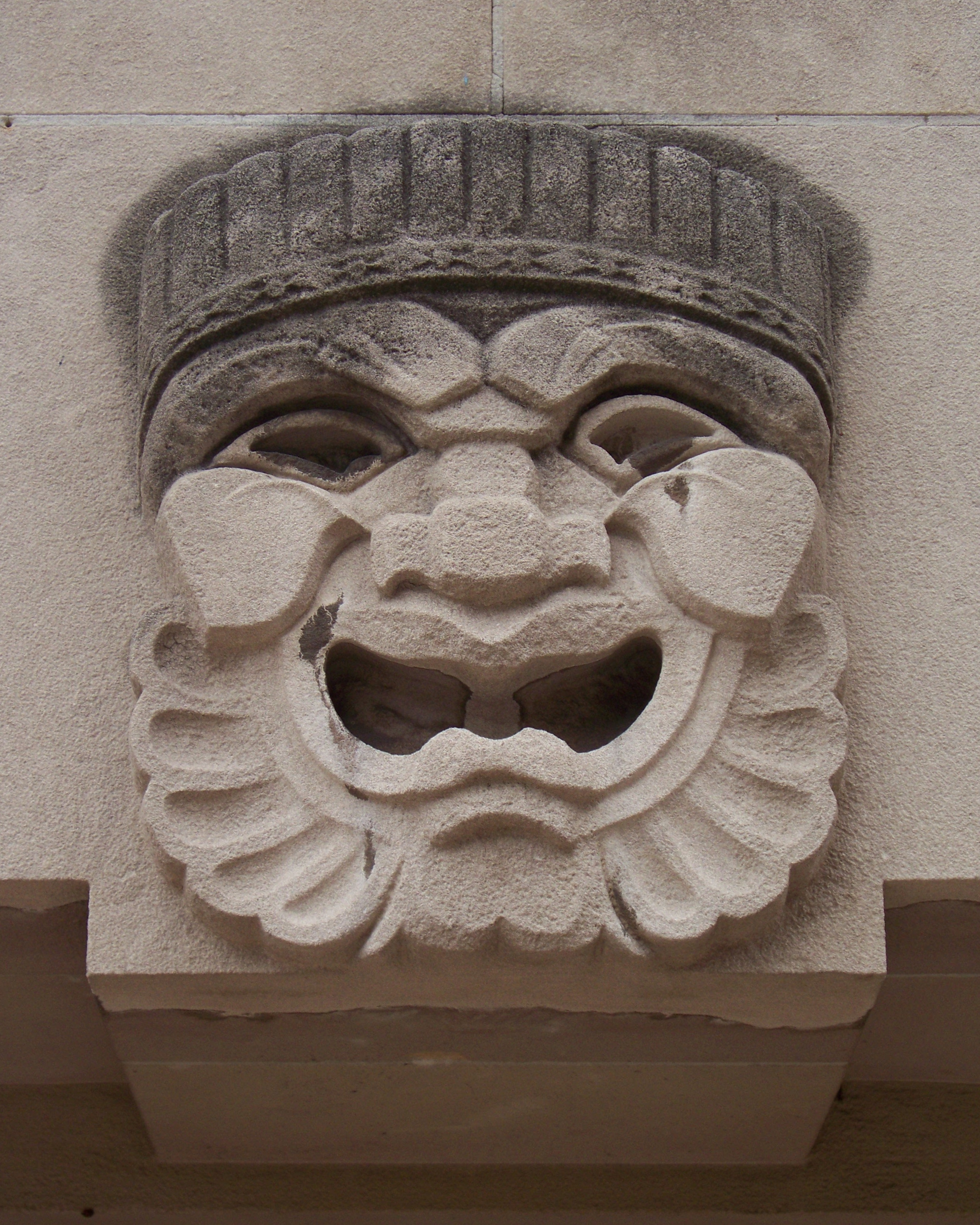
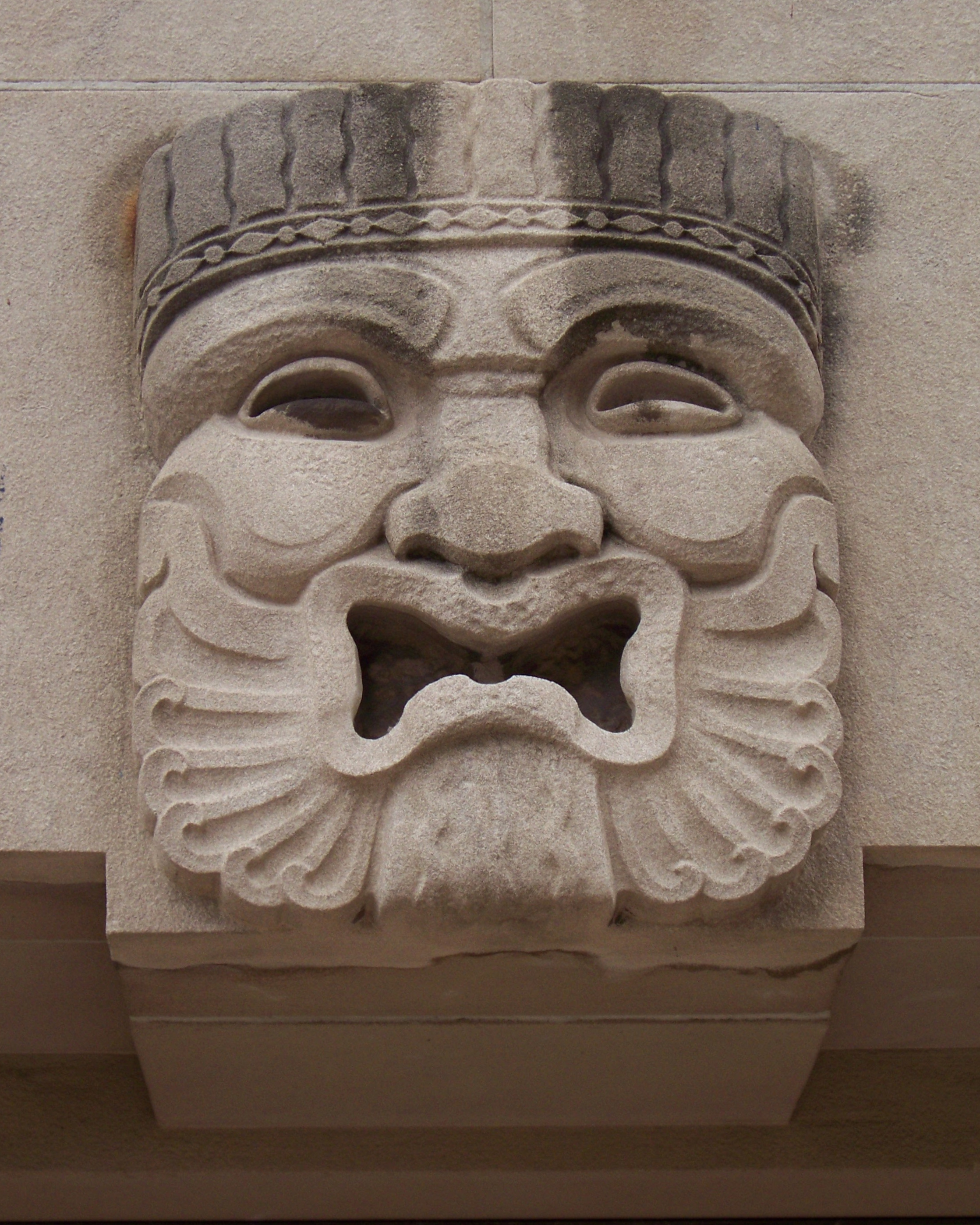
The auditorium has three exits, each one with one of the three traditional masks of Greek drama above it: Comedy, Meh, and Tragedy.