Father Pitt

Would you like to see a random article?
Of course you would.

    • About Father Pitt
    • Contents & Search
      • Alphabetical Index
    • Father Pitt’s Other Collections
      • Father Pitt’s Pittsburgh Encyclopedia
    • Privacy
    • Using These Pictures
  • Moreland-Hoffstot House, Shadyside

    Putti on the porch roof of the Moreland-Hoffstot House

    If you wanted your house to convey the message “I’m rich ppttttttthhht,” then Paul Irwin was the architect to hire. This Renaissance palace uses every trick in the architect’s vocabulary to tell the world that a millionaire lives here, and he is richer than you are. It was built in 1914 on the Fifth Avenue Millionaires’ Row, where, although it is not the biggest of the surviving mansions, it somehow manages to look like the most expensive.

    Moreland-Hoffstot House
    Moreland-Hoffstot House
    Porch
    Porch roof with putti
    Urn
    West side of the house
    Moreland-Hoffstot House
    Kodak EasyShare Z981; Samsung Galaxy A15 5G.
    November 13, 2024
  • Pittsburgh Meter Company, Homewood

    Pittsburgh Meter Company

    The Pittsburgh Meter Company building was put up at some time between 1910 and 1923, right beside the Brushton railroad yard, with a siding to serve the factory. It has been beautifully restored as the Sarah B. Campbell Enterprise Center, and it is filled with artists’ studios. One of the wonders of the big city is that we can find many buildings this size filled with artists’ studios; it reminds us why the word “civilization” means life in cities.

    Entrance to the Pittsburgh Meter Company
    Front elevation of the Pittsburgh Meter Company
    Art Nouveau decoration on the Pittsburgh Meter Company

    In the days when this building went up, it was usual for companies like this to make their main factory buildings as attractive as possible. The building itself was one of the chief advertisements for the firm, and an engraving of the building—sometimes exaggerated if the building was not as impressive as the company would like—appeared in advertisements and brochures as a guarantee that this was a solid and respectable business. Thus the entrance and the corners of this building are decorated with up-to-the-minute Art Nouveau geometric patterns in terra cotta.

    Another decorated corner
    November 13, 2024
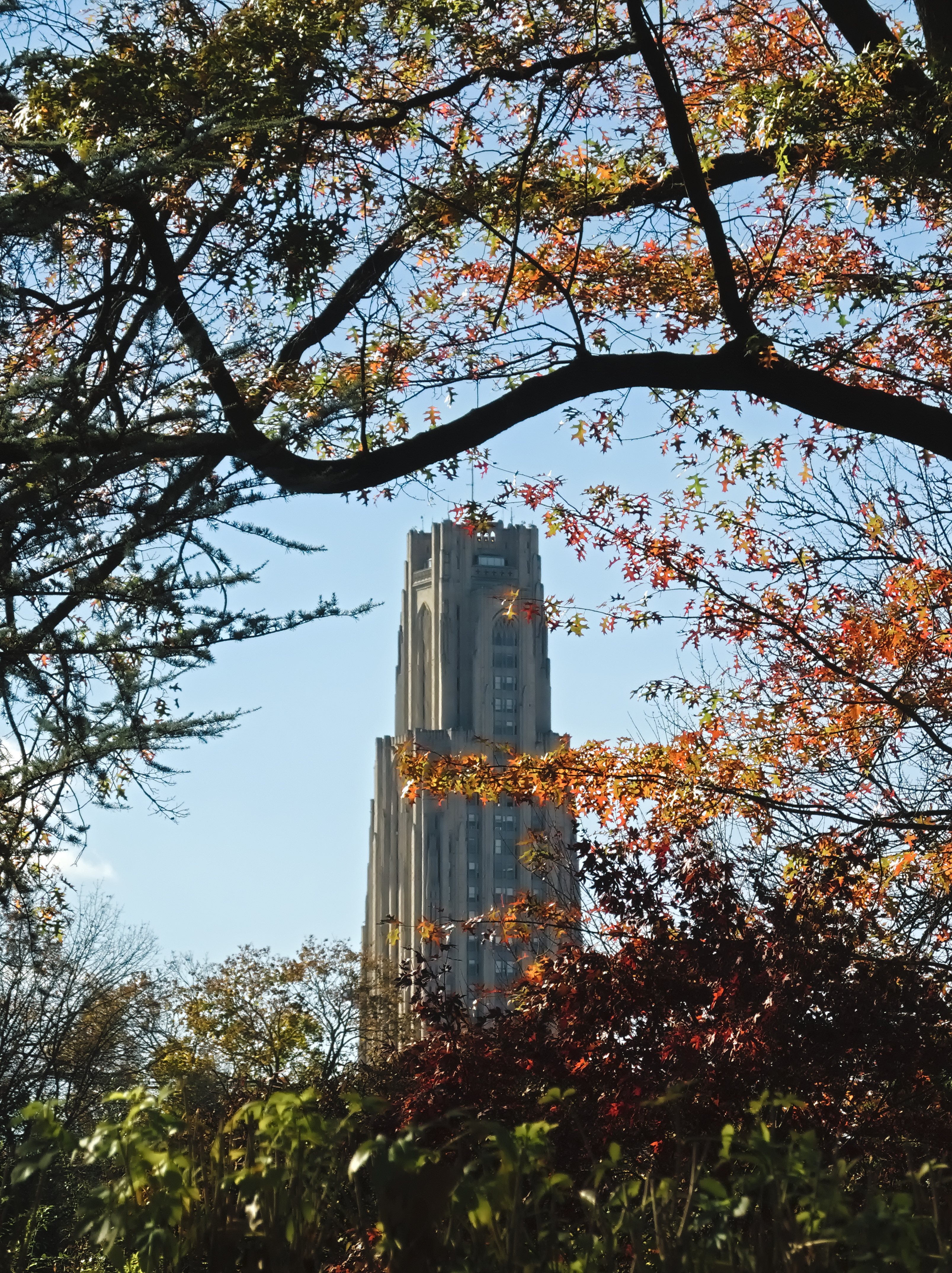
  • A November View of the Cathedral of Learning

    Cathedral of Learning through fall leaves
    Kodak EasyShare Z981.
    November 12, 2024
  • Altholl, Highland Park

    Altholl

    “Altholl” was built on Stanton Avenue for U. S. Steel executive James Scott in 1900. Stanton Avenue, which today is marked as the border between Highland Park and East Liberty on city planning maps, was already lined with grand Queen Anne mansions; but the Colonial Revival was coming into fashion, and Scott’s house must have looked bracingly modern. It has the adaptable form of the typical large Pittsburgh center-hall house of the turn of the twentieth century, which can swing from Georgian to Renaissance to Prairie Style depending on the details. We’ll call this one “eclectic Georgian.” The house is listed individually on the National Register of Historic Places.

    Center Window
    Dormer
    Ionic capital
    The James Scott House
    Fujifilm FinePix HS10.
    November 12, 2024
  • C. H. Fingeret Building, Coraopolis

    C. H. Fingeret building

    Father Pitt knows nothing about this building besides what you see here. It was probably a striking Moderne design when it went up in 1943; paint has obscured the patterned brickwork and different materials.

    Inscription: C. H. Fingeret, 1943
    C. H. Fingeret building
    C. H. Fingeret Building
    November 11, 2024
  • Three PNC Plaza

    Three PNC Plaza
    Fujifilm FinePix HS10.

    The Market Street end of Three PNC Plaza, which opened in 2009. It is tied with Three Gateway Center as our twentieth-tallest building, and it was the tallest thing built in Pittsburgh in the long skyscraper drought between the 1980s boom and the current crop of skyscrapers. The architects were Gensler and Lou Astorino.

    November 11, 2024
  • Meado’cots, Homewood

    Meado’cots

    Designed by our remarkable early modernist Frederick Scheibler, “Meado’cots” is an unusual set of terrace houses built in 1914—another Scheibler answer to the question of how to make cheap rows of houses architecturally attractive. It sat abandoned and boarded up for quite a while, but now it is inhabited and stable. The metal roofs on the central section and the cheap standard doors are not to old Pa Pitt’s taste, but they were within the budget of the new owner, and they keep the buildings standing and in good shape, with the potential for restoration with original materials later.

    Composite of the central section

    This composite of the central section from above parked-car level is made possible by a kind neighbor from across the street. He saw us struggling to hold the camera up at arm’s length and called down from a third-floor window to offer the use of his stairs for a better angle. Thank you, Homewood neighbor, for confirming Father Pitt’s impression that Homewood is a place where the neighborly virtues are strong.

    Meado’cots, end house
    Corner window

    Note the corner windows. They would become a badge of modernism in the 1940s, but here they are in 1912!

    Meado’cots
    Meado’cots
    Meado’cots
    November 10, 2024
  • Abandoned House in Homewood

    7809 Susquehanna Street

    Homewood is prospering now more than it has done in decades, but there are still many forgotten corners. This house, in the part of Homewood traditionally called Brushton, has been abandoned and forgotten for a very long time, though the other houses on the street are inhabited and well kept. Because it has been left alone for decades, it preserves details of crumbling shingle and woodwork that have been replaced on all its neighbors. It appears to have been built in the 1890s for J. M. Gruber, and it is a good example of how the Queen Anne style filtered down to the middle classes.

    Gable with shingles
    Gable and oriel
    November 10, 2024
  • St. Stanislaus Kostka Church, Strip

    St. Stanislaus Kostka Church

    Frederick Sauer designed St. Stanislaus Kostka, which was built in 1891. The church presides dramatically over the broad plaza of Smallman Street. It used to look out on a sea of railroad tracks, but its view improved considerably when the Pennsylvania Railroad built its colossal Produce Terminal.

    Rear of St. Stanislaus Kostka
    Tower of St. Stanislaus Kostka
    Rectory of St. Stanislaus Kostka
    Nikon COOLPIX P100.

    It is probable that the rectory, done in a matching style, was also designed by Sauer. The glass blocks are not an improvement, but they have kept the building standing and in use.

    November 10, 2024
  • The Forest at Gateway Center

    Forest at Gateway Center

    The modernist ideal of towers in a park often runs up against the unwillingness of developers to put any resources into the park part. Gateway Center is a notable exception. The park has always been beautifully maintained, and it was planted with an eye on the long term, so that the saplings planted decades ago have grown into a forest of mature trees in the middle of the forest of towers.

    Trees and shrubs
    More trees
    Gateway Towers through fall trees
    Fujifilm FinePix HS10.
    November 9, 2024
←Previous Page
1 … 76 77 78 79 80 … 440
Next Page→