A woodcut and accompanying article from Atkinson’s Casket. The scene is very little different now, 181 years later.
-
Saints Peter and Paul: Our Most Endangered Landmark?

There are still too many endangered landmarks in Pittsburgh, in spite of a strong local preservation movement. This one is probably doomed. All that has saved it so far is that it would cost a good deal of money to tear down, and the revival of central East Liberty has not reached this part of the neighborhood yet. As much as it would cost to tear down, it would at this point cost much more to restore, and for what? No church would spend that kind of money, and it is really suitable for no other use.


The cornerstone is dated 1857, but that comes from the older and smaller church that preceded this building. The Rev. A. A. Lambing in 1880 described that building thus: “The church, situated on Larimer Avenue, is of brick, about 75 feet in length by 40 in width, and has a tower rising from the centre in front to the height of about 100 feet…. The church, though neatly finished, lacks the leading characteristics of any particular style of architecture.” The plaque below has the data for this building:

-
Union National Bank Building
From the Architectural Annual, 1907. —This building, one of the famous Fourth Avenue bank towers, was a year old when this picture was published. It is now called “The Carlyle” and filled with expensive condominium apartments.
-
Design for the Oliver Building, 1907
From the Architectural Annual, 1907. The Oliver Building, designed by Daniel Burnham, opened in 1910.
-
Weldin’s
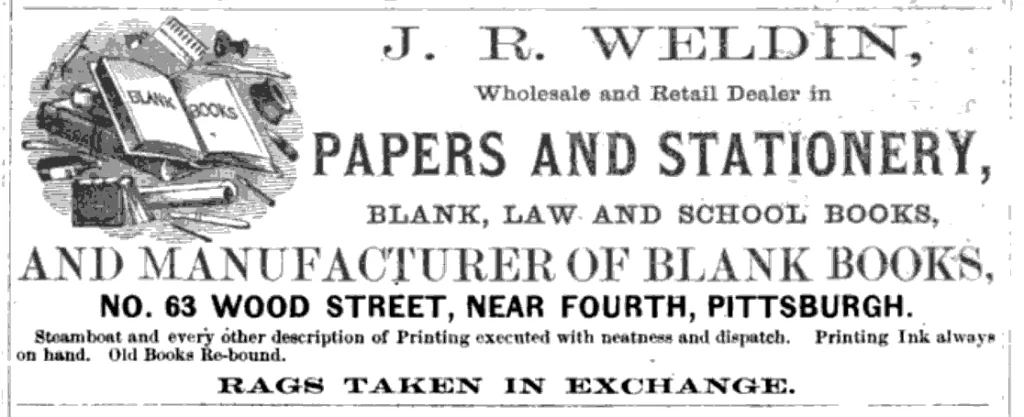
From an 1860 Pittsburgh directory. Weldin’s is still in the same place today, still selling papers and stationery. The address is now 415 Wood Street, but it is the numbers that have moved, not Weldin’s.
[Update: Weldin’s is no more: after moving to the Gulf Building for a few years, it went out of business early in the COVID pandemic.]
-
Pittsburgh in 1871

“Pittsburgh, at the junction of the Monongahela and Alleghany Rivers, is the second city in the State. It has a large trade and is noted for its commerce and its vast manufactures of iron. Alleghany City and Birmingham are connected with Pittsburgh by bridges.”
From A System of Modern Geography. The engraving may not be accurate down to the individual buildings, but it probably does a good job of conveying the general impression produced by the city just after the Civil War.