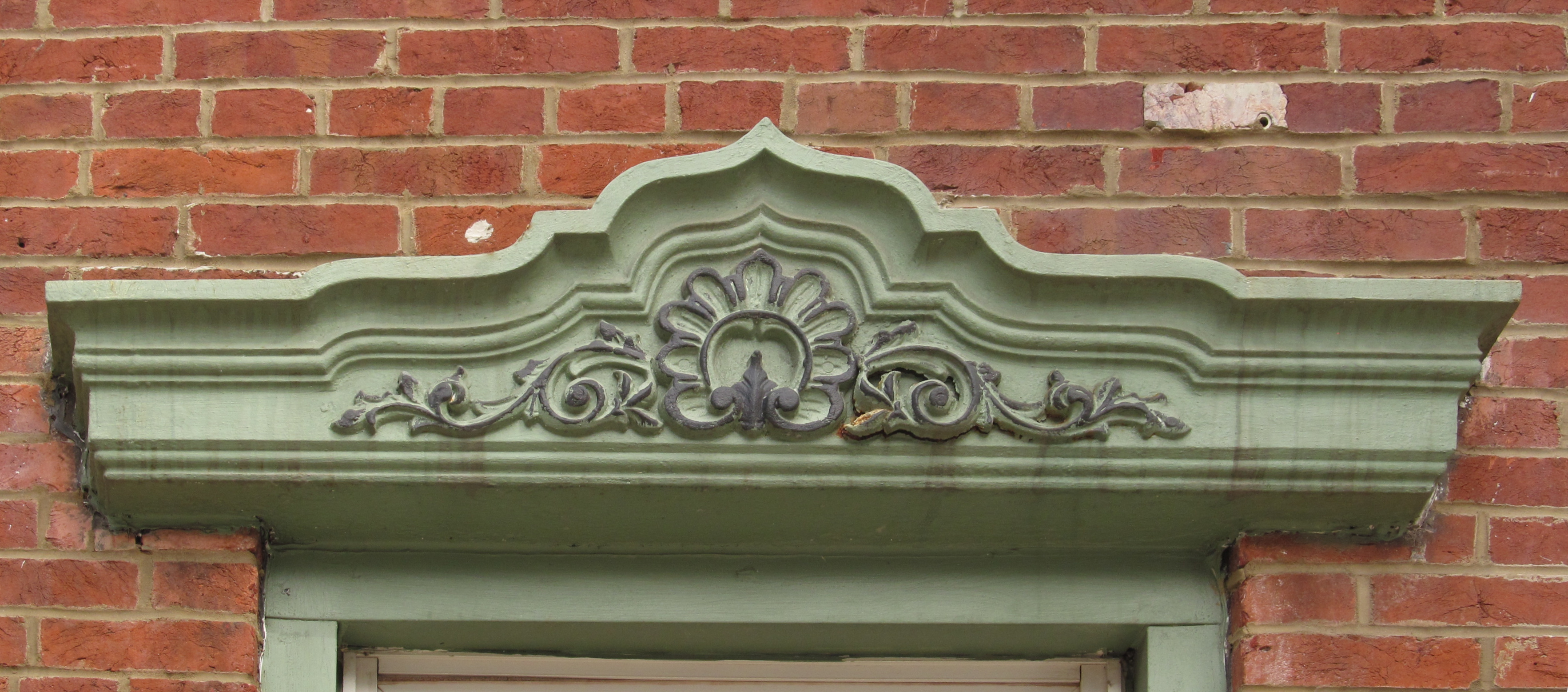
This exceptionally fine Second Empire house sits at the end of a row, and therefore has two exposed surfaces for the architect to play with. Victorian architects did not like plain flat surfaces, and whoever designed this house lost no opportunity to vary the shape and texture.
If you happen to be building a house, ask yourself this question: Which small details of this building will passers-by stop and take pictures of a century and a half from now?
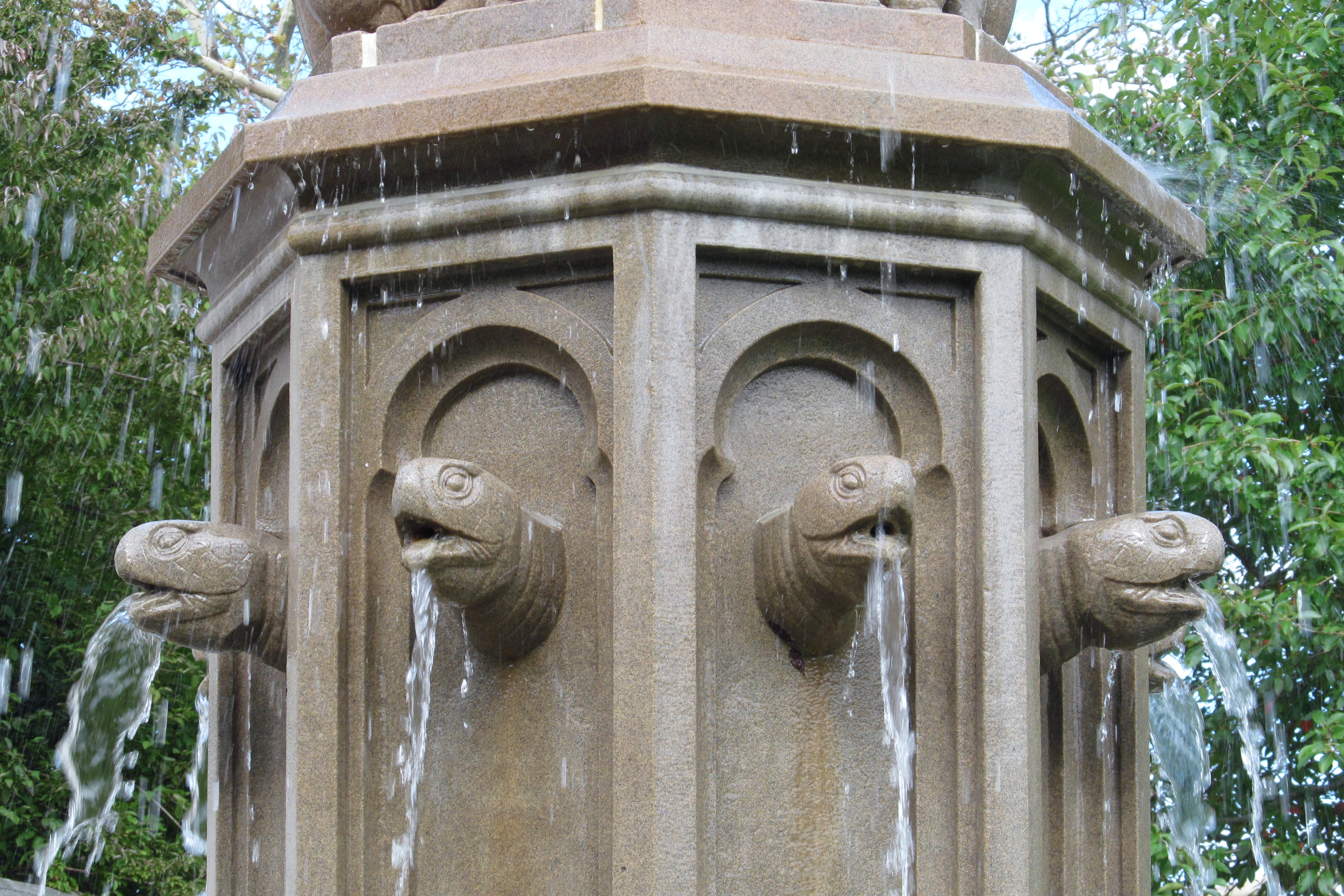
The sculptures on this whimsical fountain are by Edmond Amateis. The fountain has been carefully restored so that all the spouts are working again, and it looks almost as fresh as when it was installed at the Mellon estate.
Old Pa Pitt is not sure whether the woodwork on this South Side rowhouse is original or the work of a more recent craftsman. Either way, it is charmingly folksy, and the polychrome color scheme is well chosen to bring out the details.
At the back of the South Side, where the Flats meet the Slopes, two railroads once ran above the level of the streets. One is still one of the busiest rail lines in the city. The other has been abandoned, leaving rusty skeletons like this. In dreamy moods, old Pa Pitt likes to imagine how this right-of-way—only three short blocks from Carson Street—could be repurposed for a South Side El that would connect to the subway at Station Square.
This unassuming little church, like most of the Protestant churches in Beechview, is easy to miss: it sits on the main business street in the middle of the main business district, and it is not much larger than the small storefronts along Broadway. But it seems, if old Pa Pitt’s research is correct, to have been the work of a distinguished architect: Thomas Hannah, who designed the Keenan Building, St. Nicholas Greek Orthodox Cathedral (formerly a Congregational church), and the Western Theological Seminary (now West Hall of the Community College of Allegheny County), along with many other smaller projects like this one.
Carnegie is full of impressive churches in a wide variety of styles. This one is in a heavy Romanesque style, and the bell tower (now festooned with loudspeakers) is appropriately impressive and weighty.
Addendum: The architect was James N. Campbell; the building was probably put up in about 1893. Source: Philadelphia Real Estate Record and Builders’ Guide, September 7, 1892: “J. N. Campbell has prepared the plans for a new Methodist Church to be erected at Mansfield, Pa., at a cost of about $30,000. The pastor is Rev. G. T. Reynolds.” (Carnegie was formed from the two boroughs of Mansfield and Chartiers.)
The angle is not exaggerated in this photograph: Pittsburgh streetcars really do have to climb absurd grades like this. This is one of the small number of remaining streetcar safety islands in the city. Behind it is a tiny Central American restaurant with a reputation for excellent food; it inhabits a little building in the Spanish Mission style, which seems appropriate.
This old Romanesque church is beautifully kept up as the Attawheed Islamic Center, occupying one of the most prominent corners in the borough of Carnegie. Though the architecture is Romanesque, the tower and steeple seem uncharacteristically light for the style; old Pa Pitt always comes away with the impression that this is a Gothic building, and only seeing the rounded arches in the photograph corrects his faulty memory.