

In the suburbs the trees are mostly bare, but some trees in sheltered spots downtown are still in the process of changing. This is a little parklet next to the Dollar Bank building on Fourth Avenue.
In the suburbs the trees are mostly bare, but some trees in sheltered spots downtown are still in the process of changing. This is a little parklet next to the Dollar Bank building on Fourth Avenue.

Carved brackets and other ornaments on the entrance to one of the splendid Fourth Avenue bank towers.


The ornate top of the Benedum-Trees Building on Fourth Avenue, reflected in the glass front of the Patterson Building on Third Avenue. This is a two-color rendition, like an old postcard or a two-strip Technicolor movie. We are going to see quite a lot of Fourth Avenue and nearby in the next few days.
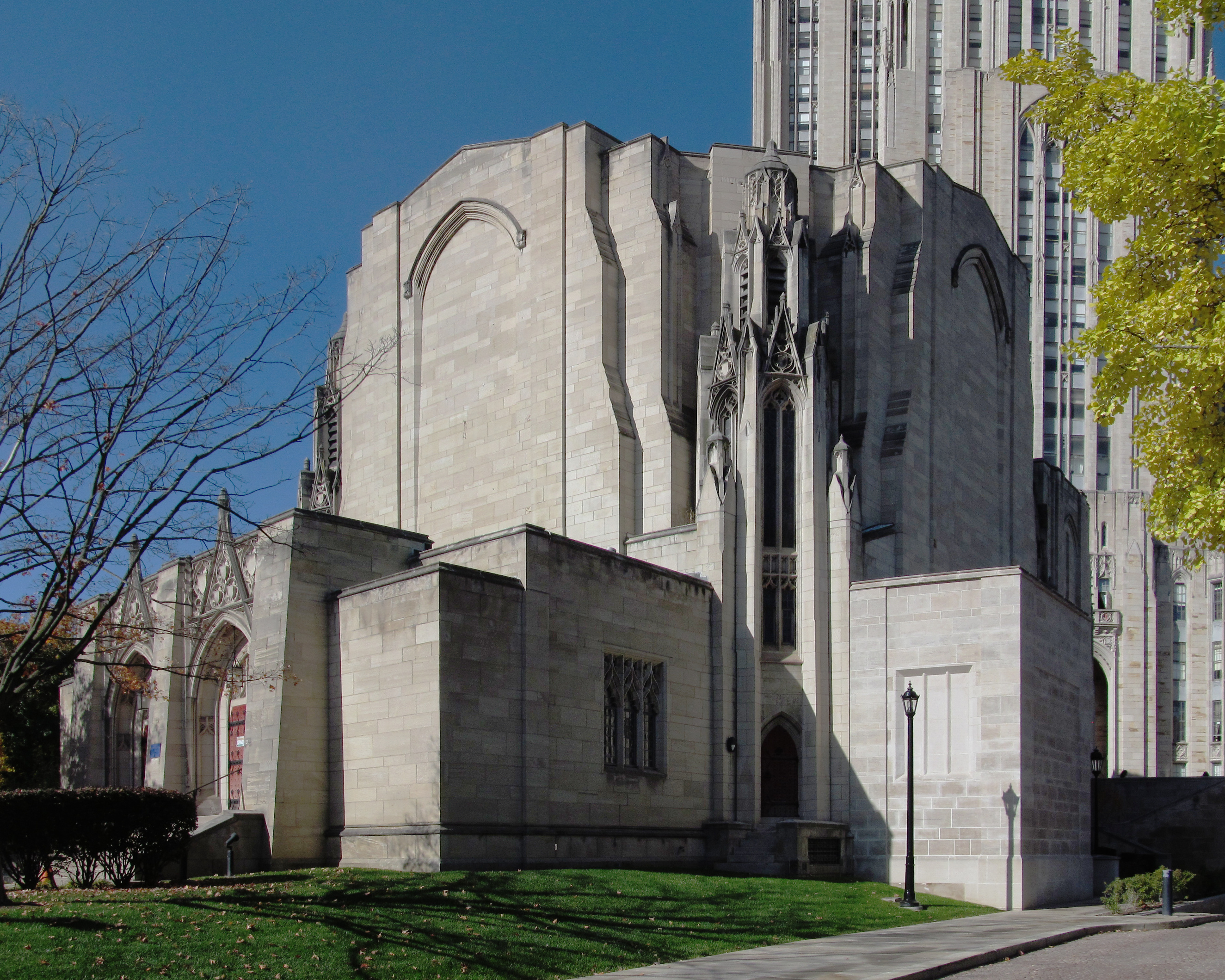
One of the cluster of Gothic buildings by Charles Z. Klauder at the heart of the University of Pittsburgh, this looks like the baptistery for the Cathedral of Learning. It houses a museum of Stephen Foster, two theaters, and the Ethelbert Nevin Collection. There was a time when Ethelbert Nevin might have got a museum of his own, but he missed his chance, and now he is an appendix to Stephen Foster.


The exceedingly improbable Skinny Building, which is five feet eight inches deep, seen in wintry December light. The picture was taken two years ago, but Father Pitt didn’t like the harsh lighting and high contrast in the original picture. Looking at it again just recently, he thought perhaps the lighting could be made into the subject of the picture if it were a black-and-white picture.
The building has been sold to PNC, which plans to display art in the upper floors.

One of the exceptionally elegant elevators in the Grand Staircase of the Carnegie Museums in Oakland.


This year’s Christmas tree lights up in animated falling-snowflake patterns.
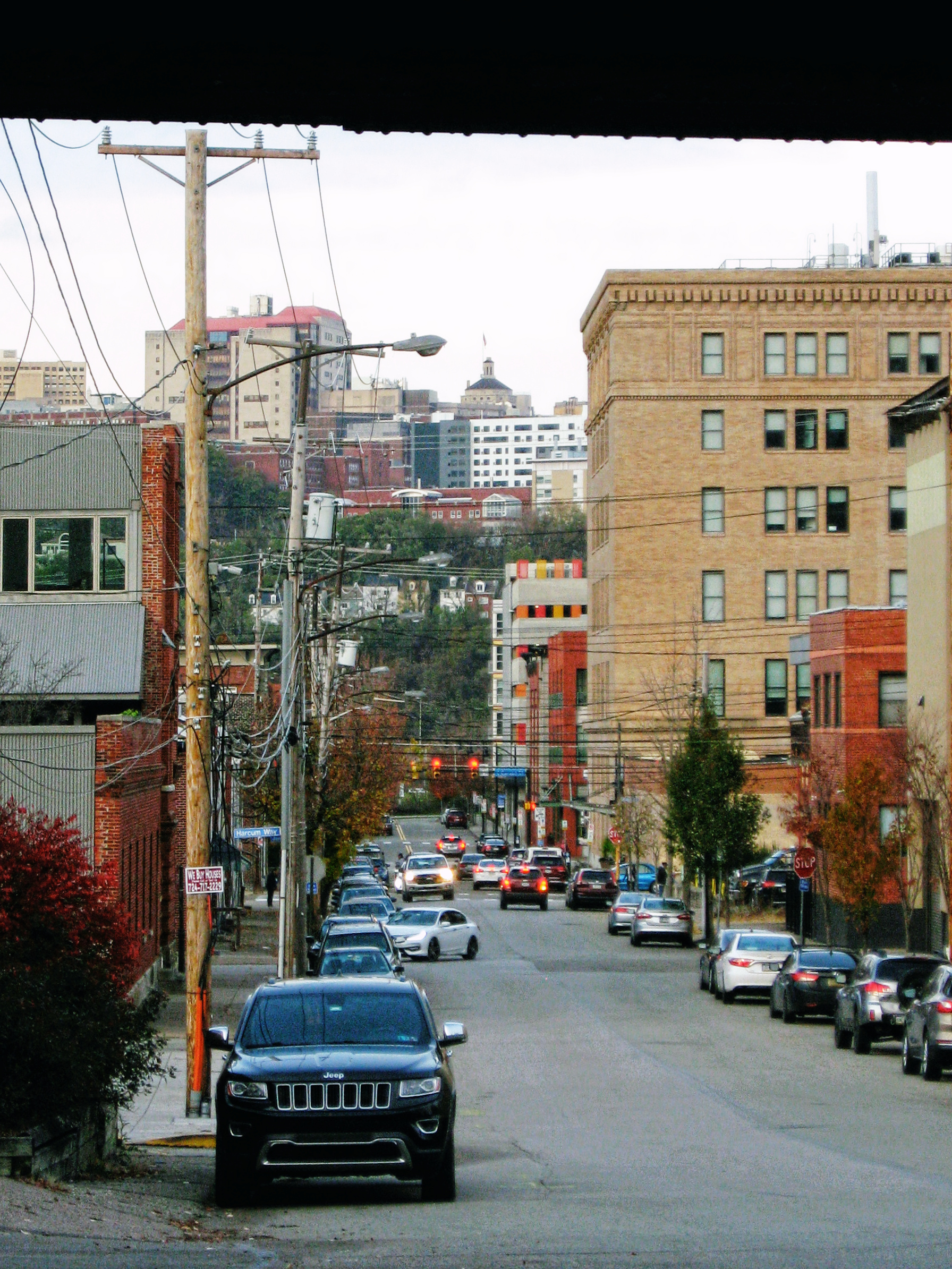
A very Pittsburghish view: a cluttered urban streetscape, seen under a railroad viaduct, with an entirely different neighborhood (in this case Oakland) on the inaccessible hill in the distance.

An Art Deco interpretation of the skyscraper style old Pa Pitt calls “Mausoleum-on-a-Stick,” in which the cap of the skyscraper is patterned after the Mausoleum at Halicarnassus. The architects, York & Sawyer, seem to have been taken with the style; they designed another Mausoleum-on-a-Stick building in the same year (1926) for Montreal. You can see a picture of it in one of old Pa Pitt’s earlier articles on Allegheny General Hospital.
The original skyscraper hospital was a marvel of practical hospital design. Everything radiates from a central core of elevators, and nothing is more than a few steps from the elevator. Later the hospital was expanded with new buildings in wildly mismatched styles, so that the complex has become the hopeless jungle of dead-end corridors and mismatched floors usual in big-city hospitals.

Sometimes old Pa Pitt decides to try some experiments with image editing. Here, for example, is a tree in color, with the rest of the picture in shades of grey. Was the result worth the effort? Well, possibly.