Father Suitbert Mollinger was the founding pastor of of Most Holy Name of Jesus parish on Troy Hill. He was also rich: he had inherited a good bit of money, and he used it in travels through Europe to buy up saints’ relics that were otherwise being tossed out in the waves of revolutions that were washing across the continent in the middle 1800s. He built this chapel to house the collection, which is probably the largest accumulation of relics in one building in the world. He dedicated it to his patron St. Anthony of Padua.
Here is St. Anthony of Padua himself, shown as he often is in art with a book on which the Christ child is sitting, referring to the story that Anthony was once meditating on Scripture when the child Jesus himself appeared to him.
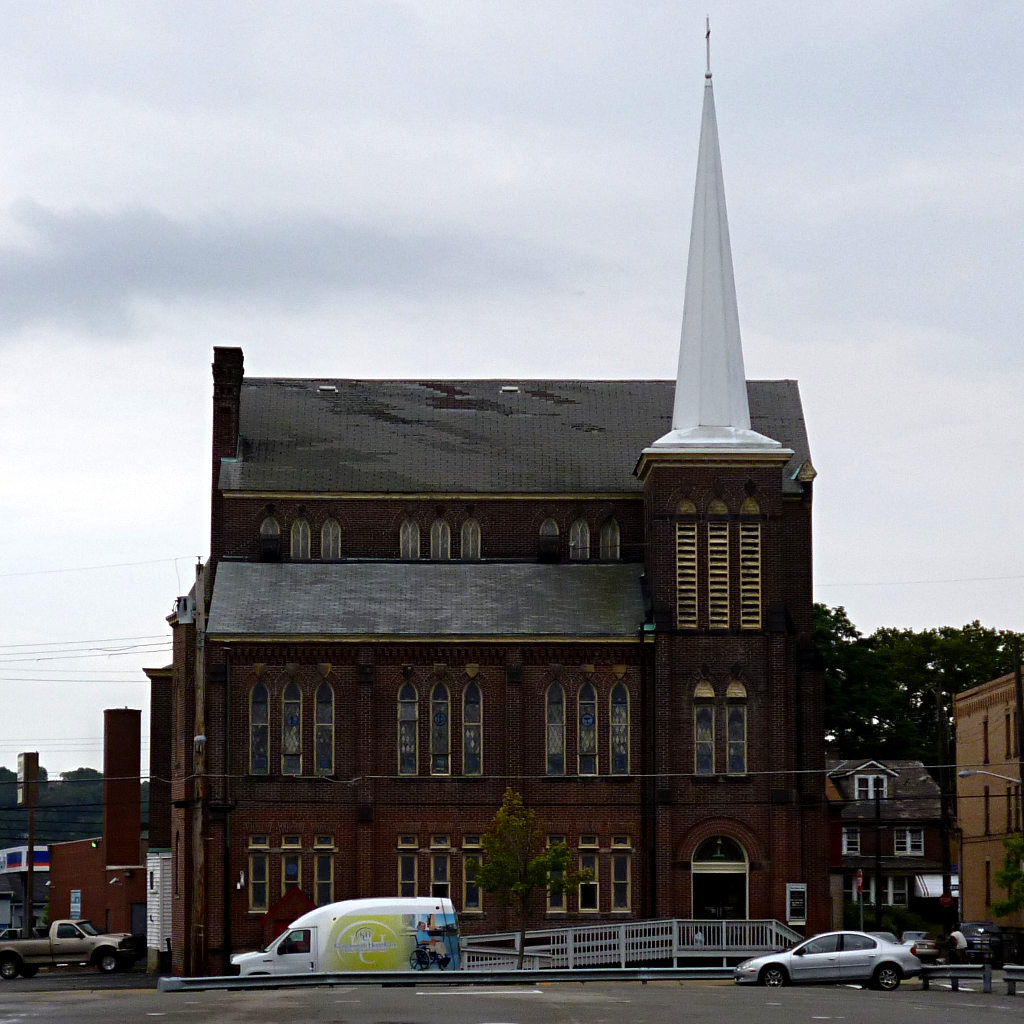
A church crammed into a tiny lot, so that it is as tall as it is long. This is one of the many city churches with the main worship space upstairs, the ground floor being devoted to Sunday-school rooms and offices.
The architect was Edward M. Butz, most famous today for the colossal Western Penitentiary.1 The construction was begun in 1894, but the church was built in two stages: at first only the ground floor was put up, with a temporary roof.
This was designed as a large open space that, when the main sanctuary was built above it, could be converted to Sunday-school rooms divided by folding doors.
The congregation grew rapidly, and less than five years later the church was completed.2
A Pittsburg Press article published when the church was dedicated in February of 1899 describes the building:
The new church is one of the handsomest church buildings in that section of Allegheny. Its dimensions are 60×75, and it is built of red brick with stone trimmings. The style is purely Gothic, and it has beautiful large glass painted windows. The building contains two stories, the lower floor being used for Sunday school purposes. It is divided in seven separate class rooms, which are connected by sliding doors. On this floor also is the pastor’s study. About 450 children are enrolled at present as Sunday school pupils.
The auditorium is situated in the second story. It has a seating capacity of 500, the seats being arranged in amphitheater style. A bell, which is said to have a more beautiful tone than any other church bell in Allegheny, has been given by William Eberhardt, of the Eberhardt & Ober Brewing company, and it is hoped that Andrew Carnegie will provide a pipe organ for the church. The members recently applied to the generous iron king and hope that their petition will receive favorable consideration.
“Grace Lutheran Church,” Commercial Gazette, July 27, 1894, p. 2. “The Grace Lutheran church of Allegheny took out a permit yesterday for the erection of a new church. It is to be located on Tinsbury street, Troy hill and will be a brick structure one story high 45×70 feet. E. M. Butts [sic] is the architect and M. Lemon the contractor. It is estimated to cost about $7,000.” ↩︎
A double house that presents the appearance of a single Second Empire mansion. French architects of the Second Empire might have turned up their Gallic snoots at the crust of lavish details, but those details are carefully balanced and create a pleasing composition, even if they are gaudy in a cheerfully Victorian way.
A “flatiron” building is a wedge-shaped building, like an old-fashioned clothes iron. There are many in Pittsburgh: our irregular streets leave odd-shaped parcels that naturally fill up with whatever buildings will fit. This one made the most of its corner location by putting a storefront there, now filled in for an apartment. The ornamental brickwork is attractive, and a few carved-stone decorations give the building properly Romanesque credentials.
Every city used to be full of stables because every city used to be full of horses. Garages have replaced stables, and most of the old stables have vanished. Here is a rare survivor. It was in the beer business for at least a century, but that it was a stable before that is fairly obvious. The grinning horse tells the story. Even then it may have been a stable for a brewery; the earliest owner old Pa Pitt has been able to trace was J. P. Ober, the Ober of Eberhardt & Ober, whose brewery at the base of this same hill is now the Penn Brewery.
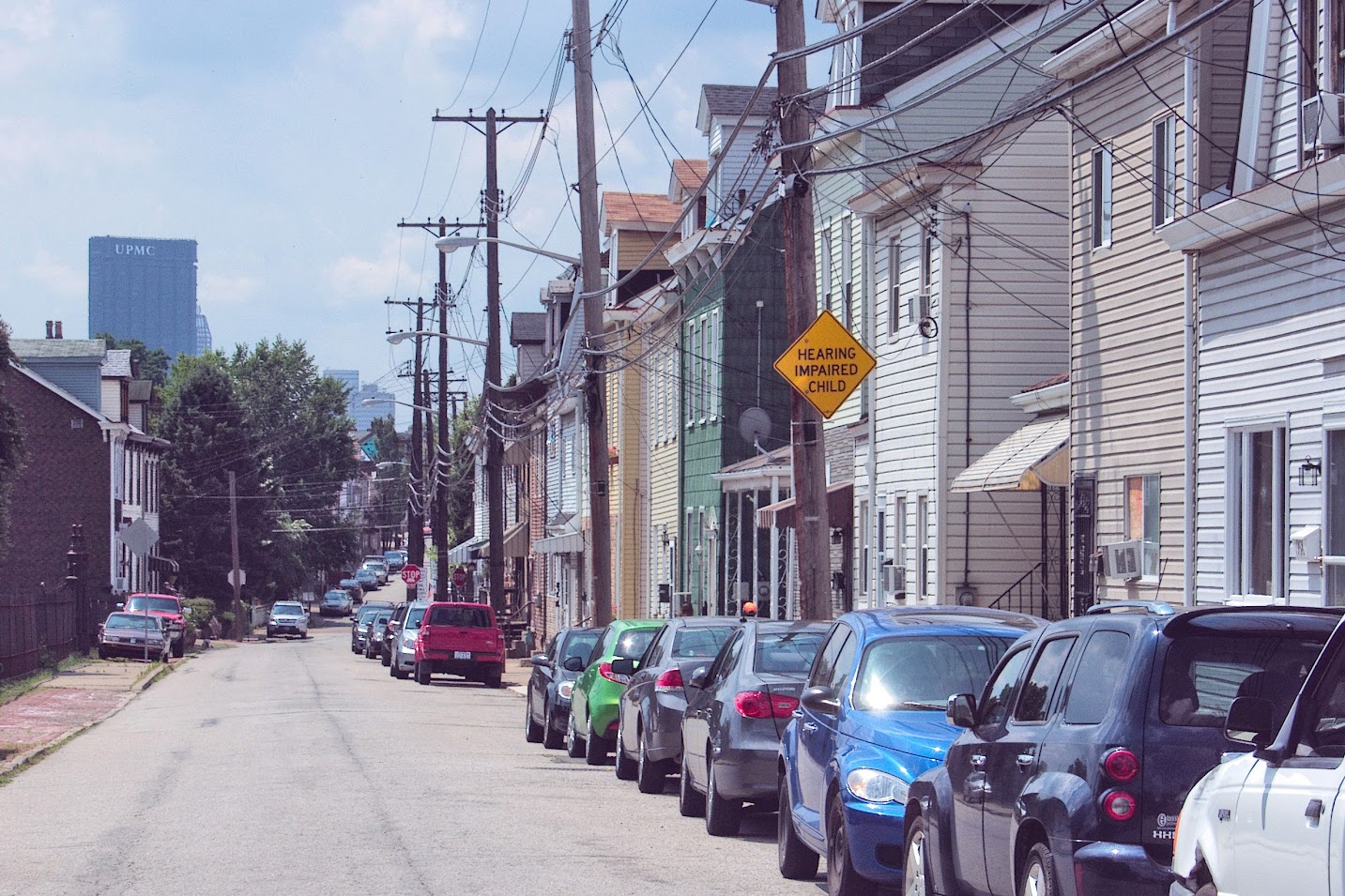
The narrow streets of Troy Hill are lined with rows of little houses with every kind of siding in every color, and unexpected views of the downtown skyline pop up here and there. This is the section of Lowrie Street across from the Voegtly Cemetery. Since the neighborhood changes so little over time, Father Pitt thought it might be fun to fiddle with the colors a little to make this picture look like an old Anscochrome slide.
It is a measure of the comprehensiveness of the Internet that old Pa Pitt is not actually the only human being on the Web who remembers Anscochrome.
A long lens shows us part of Troy Hill (foreground, above the colorful mural) and Spring Hill (background, including the high-rise apartment block) from across the Allegheny. Although the view from here makes it look as though they are all one contiguous hilltop neighborhood, in fact they are separated by the narrow Spring Garden valley, and it is something of a feat to get from Troy Hill to Spring Hill.
Taller than it is long, Grace Lutheran Church occupies a tiny space in the narrow streets of Troy Hill, a traditionally German neighborhood straddling a narrow hilltop above the Allegheny.