Category: Transit

  • Pittsburgh Rapid Transit

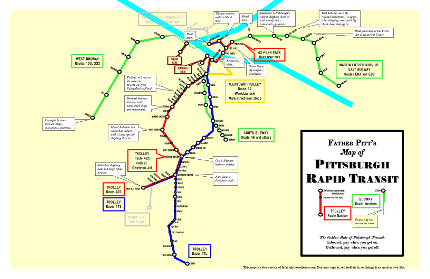
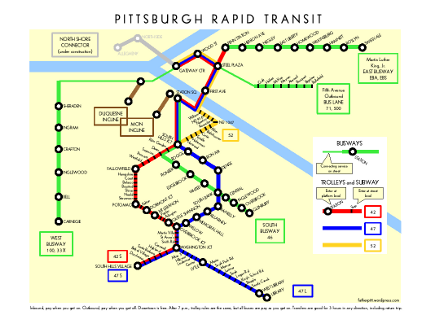
    Update: Here is old Pa Pitt’s most recent map of Pittsburgh rapid transit:

    Click on the image for a PDF copy.

    The article below is kept here for historical reasons, but the map below is out of date.

    What, again?

    Not entirely satisfied with the results of his previous attempt, Father Pitt has employed a somewhat more sophisticated drawing program to create another schematic map of Pittsburgh rapid transit. This one is simpler and more utilitarian, but also more legible, or at least old Pa Pitt hopes it is.

    Click on the image to enlarge it.
    Click on the image to enlarge it.

    Click here for a copy in PDF format (a much smaller file).

    A brief summary (a more discursive description of rapid transit in Pittsburgh is at the earlier article):

    Trolleys run on the street in Allentown and Beechview, but otherwise on their own dedicated right-of-way. Downtown they run in the subway. There are three underground stations (Steel Plaza, Wood Street, Gateway Center) and one elevated station (First Avenue); all other stations and stops are at ground level.

    Inclines are funicular railways that climb the steep slope of Mount Washington.

    Busways are like rubber-tired metro lines, with complete grade separation, infrequent stops, and high speeds between stops. Most busway routes make a loop on the street downtown.

    The contraflow bus lane in Oakland is the sort of thing that counts as “bus rapid transit” in other cities. It helps, but it’s not good enough.

    In addition to these lines, of course, there are nearly two hundred bus routes that run in street traffic. See the Port Authority’s web site for detailed schedules. There are also numerous interurban routes run by various transit authorities outside Allegheny County.

    An update: Mr. Ken Zapinski remarks, “I would suggest adding the HOV lanes to the north which carry express/commuter service from the North Hills, but including that makes configuration of the map difficult.”

    The HOV (“high-occupancy vehicle”) lanes he mentions are a set of inner lanes, completely separated from the main highway, that run from the Lower Hill just outside downtown up the middle of Interstate 579 and 279. They are open to inbound traffic in the morning and outbound traffic in the evening, and they do carry commuter buses as well as the few carpoolers who manage to comply with the absurdly lenient restriction to vehicles with two or more occupants.

    In the late 1980s and early 1990s, the Port Authority published rapid-transit maps including those HOV lanes as well as the trolleys and busways (the West Busway had not been built yet). Since then, for some reason, the Port Authority has not published a good map of the whole system, preferring to hand out individual maps of the various parts of it.

    Father Pitt considered adding the HOV lanes, but left them out for two reasons: first, because there are no stops along the way, meaning that the ordinary carless traveler cannot use their presence on the map to answer the question of how to get from here to there; and second, because (as Mr. Zapinski remarks) they make the map harder to draw.

    The HOV lanes do, however, materially improve commuting from the North Hills; the buses have a far easier time of it than the ordinary one-per-car commuter who sits in traffic and curses.  Old Pa Pitt may reconsider the map some day soon.

    Another update: Chris Briem at Null Space (a remarkably intelligent blog on Pittsburgh economic issues) kindly links to this article and remarks, “Not sure the Mon Incline counts as rapid, but I won’t quibble.”

    Father Pitt uses the term “rapid transit” in place of the far more cumbersome “fixed-guideway systems,” which is what the Port Authority prefers. English is not a bureaucrat’s first language. Except for the Allentown and Beechview street-running sections on the trolley lines, what all these lines have in common is that they avoid street traffic. (And it’s hard to call what happens in Allentown or Beechview “traffic.”)

    As for the inclines, they move slowly, but it would be hard to imagine a way of getting from the bottom to the top of Mount Washington that would be faster and didn’t involve a rocket pack.
  • Schematic Map of Pittsburgh Rapid Transit

    Update: This article is kept here for historical reasons, but the map here is out of date. For an up-to-date map, see Father Pitt’s latest article on Pittsburgh rapid transit.

    Father Pitt has already offered one map of Pittsburgh rapid transit. That one was meant to show the attractions along the way. This new map is an attempt at a schematic map, somewhat after the manner of the famous London Tube maps, that will fit comfortably on a single sheet of letter-size paper. Old Pa Pitt would not have attempted such a thing if the Port Authority had created a useful rapid-transit system map, but that august body has not done so, instead doling out partial maps in bits and pieces.

    This map is an early draft, on which comments are invited.

    schematic-pittsburgh-rapid-transit-2
    Click on the image for a full-size PDF version.

    And now, a few words about Pittsburgh’s rapid-transit system, which old Pa Pitt (who is admittedly prejudiced) thinks is an admirable start, better than almost any other system for a city of this size in the United States.

    What is rapid transit, and how does it differ from plain old non-rapid transit? For our purposes, “rapid transit” means what the Port Authority calls “fixed-guideway systems”: that is, anything that has its own dedicated track. In addition to the lines on this map, there are nearly two hundred bus routes that run on the street in ordinary traffic.

    Trolleys or streetcars (the terms are interchangeable here) run on rails. The Port Authority calls the cars LRVs, for “light-rail vehicles,” but no one else calls them that. Depending on how you count, there are somewhere from three to six routes.

    Route 52 runs almost entirely on the street. Routes 42C and 42S run on the street in Beechview, but on their own right-of-way everywhere else. Routes 47L and 47S run entirely on their own right-of-way. The short spur to Penn Station is served by only two rush-hour cars (Route 42 Penn Park) a day.

    Downtown, the cars run in a clean and pleasant subway. Routes 42 and 47 also run underground between Station Square and South Hills Junction, and Route 42 runs underground between Dormont Junction and Mount Lebanon. For reasons old Pa Pitt doesn’t pretend to understand, no one around here calls those other streetcar tunnels subways.

    Subway stations, and major stations elsewhere, have high-level platforms on the same level as the floor of the car. Other stops on the lines have street-level platforms (if they have platforms at all). Because of this odd system, Pittsburgh streetcars have to be specially made with entrances at two levels. You can see the two levels plainly in this picture:

    The disproportionate rail coverage of the South Hills is an accident of history. When shortsighted bureaucrats were abandoning streetcar lines right and left, the ones that stayed were the ones that had their own right-of-way for most of the route, and those happened to be in the South Hills. The exception is the Allentown Trolley, Route 52, which survives because it makes a vitally useful bypass for the other routes if the transit tunnel under Mount Washington has to be closed for some reason.

    Busways in Pittsburgh are not like the half-hearted “bus rapid transit” lines some cities like Cleveland and Boston are installing. They’re more like rubber-tired metro lines. Like a true metro, they are entirely grade-separated, meaning that they never intersect with any cross streets or join with street traffic. Also like a true metro, they stop infrequently and reach high speeds between stops—sixty miles an hour or more. The main difference is that, at the ends of the busway, the giant articulated buses can go on into the streets; most busway routes make a loop downtown.

    Father Pitt thinks busways are inferior to rail transit, for the simple reason that no one loves a bus, no matter how quick or convenient. Rail transit attracts more riders. Nevertheless, the busways (which were built with eventual conversion to rail in mind) are efficient and very fast. Pittsburgh invented the busway (the South Busway was the first one in the world, as far as we know), and we got it right the first time.

    Inclines are funicular railways that climb steep hillsides. The cars come in pairs attached to a long cable; the weight of one car going down helps pull the other car up. The cars move slowly, but because an incline goes straight up an otherwise impassable hill, it’s the fastest way to get from up to down or down to up.

    Pa Pitt debated with himself whether to include the Fifth Avenue bus lane, but eventually decided to keep it. Outbound through Soho and Oakland, the buses travel against the flow of traffic in a lane of their own, so that even in rush hour they move smoothly through the most congested part of the city. And the link to Oakland is so vital that including it markedly increases the utility of the map. The inclusion of the bus lane, however, should not be taken as a sign of old Pa Pitt’s acquiescence in the current state of affairs. Some form of subway, trolley, monorail, maglev, or teleportation between downtown and Oakland is still our highest transit priority.

  • 150 Years of Light Rail

    Click on the picture to enlarge it.

    Father Pitt has learned that the city of Phoenix in Arizona, a largely mythological state, has just begun to enjoy the many benefits of a modern light-rail transit system—or, to use a better and more descriptive term, streetcars. Seeing that cheering news, old Pa Pitt tried to remember how long Pittsburgh has had light-rail transit. After jogging his memory, he came up with an answer: exactly 150 years. The first streetcar tracks were laid in 1859.

    One hundred fifty years of streetcars! This seems like a momentous occasion, an anniversary to celebrate with fireworks and cake. Those first cars were drawn by horses, of course. After them came cable cars, much like the ones in San Francisco. They lasted only a short time before they were replaced by electric traction, which is what we still use today.

    Many things have changed since then. Much of the street trackage has been replaced by buses, although streetcars still run on the street in Allentown and Beechview. In the 1980s, the streetcars downtown finally moved into the subway that Pittsburghers had been clamoring for since the turn of the twentieth century or before. But  “light rail” service in one form or another has been continuous since before the Civil War, which is an enviable record few American cities can match. Here is a wonderful collection of pictures of Pittsburgh streetcars, mostly from the PCC era.

    So to the citizens of Phoenix, Father Pitt sends his warmest greetings: Welcome to the mechanical age! Based on his experience over the last century and a half, Pa Pitt thinks you’re going to like it here.

  • In the Subway

    Click on the picture to enlarge it.

    The streetcar lines from the South Hills all converge downtown and go into a clean and pleasant subway. Steel Plaza station, shown here, is where the short line to Penn Station (served only in rush hour) branches off the main line. Here a not-in-service car from Penn Station sits at the platform waiting for its next assignment.

  • Map of Pittsburgh Rapid Transit

    Update: Here is old Pa Pitt’s most recent map of Pittsburgh rapid transit:

    Click on the image for a PDF copy.

    The article below is kept here for historical reasons, but the map below is out of date.

    Public transit, like everything else in Pittsburgh, is wonderfully confusing. We have buses, busways, streetcars or trolleys, inclines, and subways (the main one where the streetcars run downtown, as well as a subway for the streetcars in Mount Lebanon, a transit tunnel for buses and streetcars under Mount Washington, and a long tunnel on the West Busway).

    For our purposes, “rapid transit” means what the Port Authority bureaucrats call “fixed-guideway systems,” meaning transit that runs on rails or on its own dedicated track. Streetcars or trolleys (the terms are interchangeable here) sometimes run on the street with the rest of the traffic, but they have their own rails. Busways are high-speed tracks for buses that work like subways, with infrequent stations rather than a stop on every corner. Inclines go from down to up or up to down.

    If you prowl around the Port Authority’s Web site long enough, you can find maps of most of these things. But you can’t find a map that tells you how much fun you can have. Here’s where old Pa Pitt steps in with a map that shows you how to use rapid transit to get to some of Pittsburgh’s main attractions.

    The obvious missing piece in our transit system is a rapid-transit line to Oakland, the intellectual heart of Pittsburgh. Bus service from downtown to Oakland is frequent, but many people refuse to ride buses who would ride rapid transit. There is, however, good reason to hope that the omission will be corrected soon. Meanwhile, here is a map of the otherwise excellent system we do have. Click on the image to download the map in PDF form.

    Click on the image to download the map in PDF format.
    Click on the image to download the map in PDF format.
  • Streetcars Still Run in Beechview

    Many Pittsburghers from between the rivers firmly believe that streetcars are extinct in Pittsburgh. They are indeed extinct between the rivers, except where they run underground in the subway; but south of the Mon they still run on the street in Allentown and Beechview, and on their own right-of-way far out into the southern suburbs.

    Above, a Route 42S car rolls outbound up Broadway in Beechview. Below, an inbound car begins its crossing of the viaduct between Fallowfield and Westfield.

  • Before We Get That Subway…

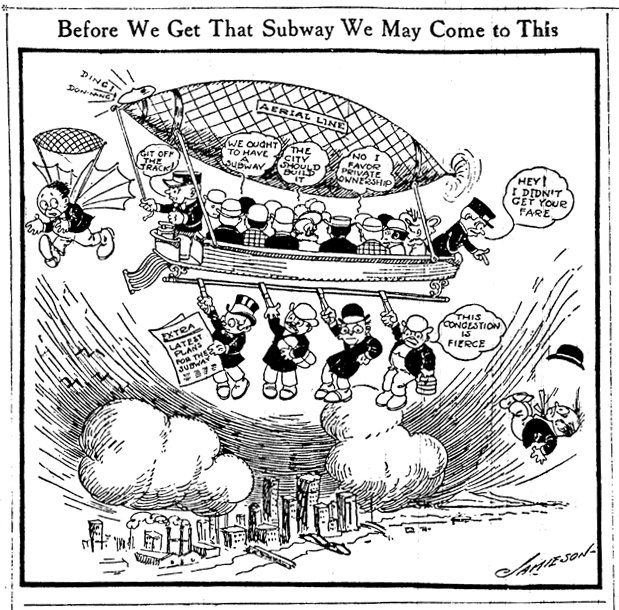
    An editorial cartoon by Jamieson of the Dispatch from 1906, when the need for a subway in Pittsburgh was already obvious and urgent. The subway downtown opened in 1985, seventy-nine years later.

  • Streetcars Passing in Beechview

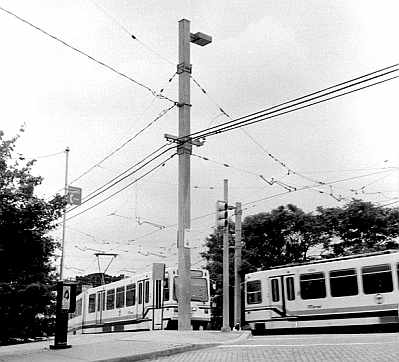
    Two streetcars pass at the intersection of Beechview Avenue and Broadway. Streetcars of various sorts have run on Broadway for more than a century. This picture was taken a few years ago; these Siemens cars have since been rebuilt and repainted in the new Port Authority livery.
  • Interurban Lines in 1914

    This 1914 map of “Electric Lines of the Pittsburgh District” (click to enlarge) shows the remarkable system of interurban cars that ran through every substantial town in southwestern Pennsylvania. The line that runs almost due south from Pittsburgh is still active as far as Library in the form of the 47L streetcar route.
  • Streetcar in the Snow

    pcc.jpg

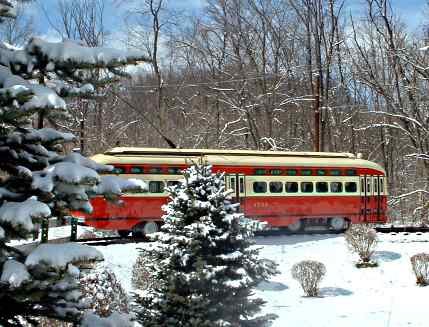
    PCC car no. 1711, restored to Pittsburgh Railways red and cream, at the Pennsylvania Trolley Museum. This car was active on Route 47 until a few years ago, when the PCC cars were finally retired.