John Lewis Beatty, who gave us many fine churches throughout the city and suburbs, was a grand old man of Pittsburgh church architecture by the time he designed this church, built in 1928. Today the building belongs to Nabhi Christian Ministries, and it seems to be in very good hands.
The most extraordinary riot of polychrome terra cotta in Pittsburgh greets students coming into this school, still in use as the Catalyst Academy charter school. The architect was Edward Weber, who was commissioned by the Pittsburgh school system’s supervising architect Marion Steen; the school was built in 1937–1938.
On a school that is full of surprises, the second-most-surprising thing is the “five races of man” frieze that runs along the top of the front. In the early twentieth century, it was common to divide the human species into five “races”: African, Asian, Caucasian, American Indian, and Australian. Modern scientists would say that the “five races” theory is untenable, but it was widely accepted in the 1930s, and this school was topped with a visual assertion that it would be for everybody.
Caucasian Man looks quite surprised to find himself stuck in a frieze.
We said that the “five races of man” were the second-most-surprising thing about the school. The most surprising thing is the Aztec or Central American influence in the decoration. It was very rare for American architects to look to the Americas for inspiration, and almost unheard-of in Pittsburgh: the only other significant example old Pa Pitt can think of at the moment is the South Park Golf Club by Henry Hornbostel.
This entrance seems plain after the explosion of terra cotta at the two main entrances, but the details are carefully balanced. Note the textured brickwork, with a brick sticking out at regular intervals to create shadowed detail on what would otherwise be a plain brick wall.
Kiehnel & Elliott, one of the few Pittsburgh firms to pick up German-style Art Nouveau and run with it, designed this firehouse, which was built in 1908. The decorations are full of the elegant Jugendstil whimsy that was Richard Kiehnel’s specialty.
Dedicated in 1901, this was an institution created by and for Black women, though it had financial support from some of Pittsburgh’s wealthy White families. After the Home closed, it was a Baptist church for a while; but now it is vacant and slowly decaying. We hope something can be done to rescue it, because it has a fascinating story to tell—in fact, many fascinating stories.
The home was a comfortable place for women who had no family to support them: it had beautiful appointments inside and spacious grounds outside. A long article in the Pittsburg Post for August 25, 1901, described the institution and its new home, and introduced us to some of the ladies who would be living there. We’ll transcribe the whole article down below the pictures.
Thomas Scott designed this palatial waterworks, which stands in a little enclave of the city of Pittsburgh on the north shore of the Allegheny just outside Aspinwall. As he did with the Mission Pumping Station on the South Side Slopes, he decorated this one with elaborate grotesque heads and other classical effusions.
You never know what you might find when you go trawling in the depths of the archives. These pictures were taken in September of 2014, but old Pa Pitt never published them. Why not? His memory is vague, but he suspects it was because he was planning to publish them when he worked out the history of the building, and he never did work it out. Finding the pictures by random luck the other day stimulated him to finish the job, and here they are.
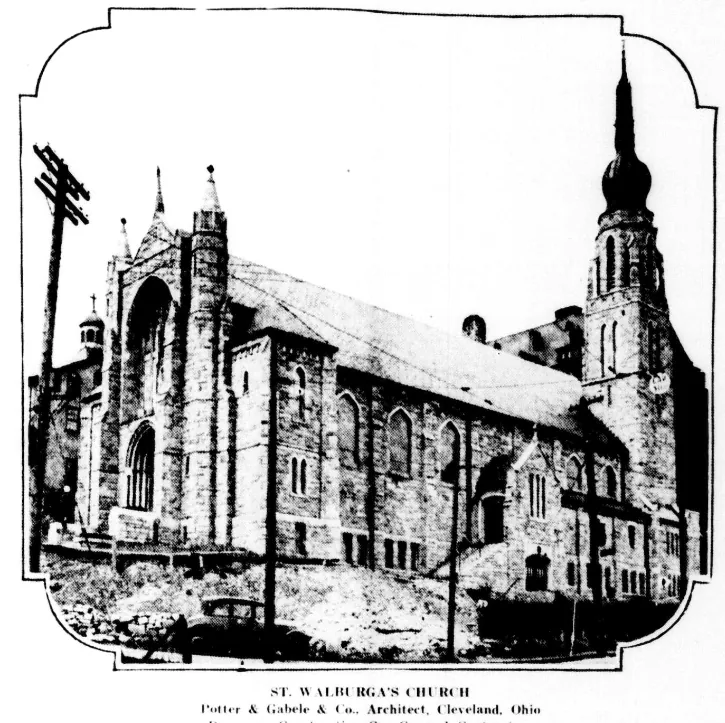
St. Walburga’s was a German parish founded in 1903—the last ethnic German parish founded in the city of Pittsburgh. The cornerstone of this building was laid in April of 1927; the building was dedicated a year later in April of 1928. The architects were the Cleveland firm of Potter & Gabele & Co., and if Father Pitt told you how much time he spent trying to find that information before finally locating it in the Pittsburgh Catholic for April 19, 1928, you would wonder a little about whether he should be regarded as competent to manage his own life.
J. Ellsworth Potter was a successful architect who designed churches in traditional styles until his death in 1958. Henry Charles Gabele was associated with Potter until 1932, but after that seems to have fizzled out as an architect (see a brief notice in this PDF Cleveland Architects Database).
St. Walburga’s parish was suppressed in 1966, a victim of postwar demographic change. Today the building belongs to the Cornerstone Baptist Church, whose congregation obviously treasures it and keeps it in beautiful shape.