
Our headline is a bit of an exaggeration, but only a bit. Today Pittsburgh City Council is a group of nine representatives; but in the early 1900s, it was a bicameral circus consisting of a a select council and a common council, with the membership adding up to more than a hundred on a good day. It was notoriously corrupt, which made it very amusing that one of the chief arguments in favor of the annexation of Allegheny was the corruption of the smaller city’s government. Mayor George Guthrie had been elected on promises of reform and did his best, but he was one man against an army of petty crooks.
Here is the story of how a few civic-minded leaders decided to do something about that corruption. They succeeded—but it cost them a lot.
The author, Albert Jay Nock, was quite a character himself. He was a confessed elitist who thought that democracy could produce only the kind of corruption of which Pittsburgh was an extreme example. He was a free-trade fanatic who hated tariffs. He was accused of being anti-Jewish; his response was that it was true that he didn’t like Jews, but not because they were Jews but because they were folks, and he didn’t like folks. In this story, though, his tragic hero and shining incorruptible figure is Jewish: A. Leo Weil. Nock takes pains to point out the contrast between his disinterested civic heroism and the comfortable corruption of “Pittsburg the pious, church-going city, the focus of stanch, uncompromising North-of-Ireland Presbyterianism for the whole United States.” “Is the iron-clad militant Protestantism of Pittsburg worth having if the city has to feel its way toward elementary social Christianity under the leadership of a Jew?”
One thing even his detractors agreed on: Albert Jay Nock was an exceptionally entertaining writer. Without further introduction, then, here is as exciting a detective story as anything Dashiell Hammett could have cooked up.
What a Few Men Did in Pittsburg
A True Detective Story of Today
By Albert Jay Nock
From The American Magazine, October, 1910, beginning on page 808.
As you scan this drama, do not forget that it took place in Pittsburg. Pittsburg, the great industrial capital, the home of immense industrial fortunes, the incubator of millionaires, the scene of luxury and extravagance almost unparalleled; the seat of magnificently equipped schools, museums, noble temples of religion, literature, art and music; Pittsburg, finally, the pious, church-going city, the focus of stanch, uncompromising North-of-Ireland Presbyterianism for the whole United States.
Pittsburg is very proud of all this.
Pittsburg, again, the citadel of the protective tariff; the obedient creature of the Pennsylvania bipartisan political machine; the pocket borough of Magee, Flinn, Bigelow; robbed right and left by its own city councils; every grain of its earth and breath of its air charged with misery for a huge army of industrial workers who exist under conditions of unspeakable hardness and hideousness, until they die of typhoid, accident, or overstrain. And for these things very few people in Pittsburg have seemed to care.
Why? The working people are too tired to care about anything. They have to work so hard to hold their jobs that they have no spirit or strength for interest in anything else. Some of the others do care, really, but they have not seemed to care, for the simple reason that the economic situation underlies everything.
It underlies the industrial system, the schools, art galleries, the social life, the Scotch Protestantism, and the municipal politics.
“Turn the rascals out!” is easy talk; but a hand laid on the Pittsburg city machine is instantaneously felt at Harrisburg, at Washington, and the current flies around the circuit back to the big offices in the Carnegie Building. There is a trunk nerve running from the city machine through the county machine, the State machine, to Penrose, Oliver, Knox, Dalzell, to the protective tariff—and there you make automatic connection with Pittsburg’s pocketbook and industrial supremacy, and secondarily with the libraries and museums and trade schools and all the rest of it.
Pittsburg’s good people have winked at their municipal evils and put up with them as a bargain for the integrity of the protective principle. Quay, Penrose, Oliver, Knox, and the rest cost a good deal in terms of honor and decency, and cost a little money too, indirectly—that is, it should be passed up to the taxpayers—but we had to keep them in their places or endanger our chances for getting very rich, and putting Pittsburg on the throne of industrial supremacy, and having the schools, libraries, art galleries, churches, and all the good things that flesh is heir to.
The great theatre in Copenhagen bears the legend, “Not for Pleasure Only.” Read this as a detective story by all means; but think at least once or twice of the economic conditions that it indicates.
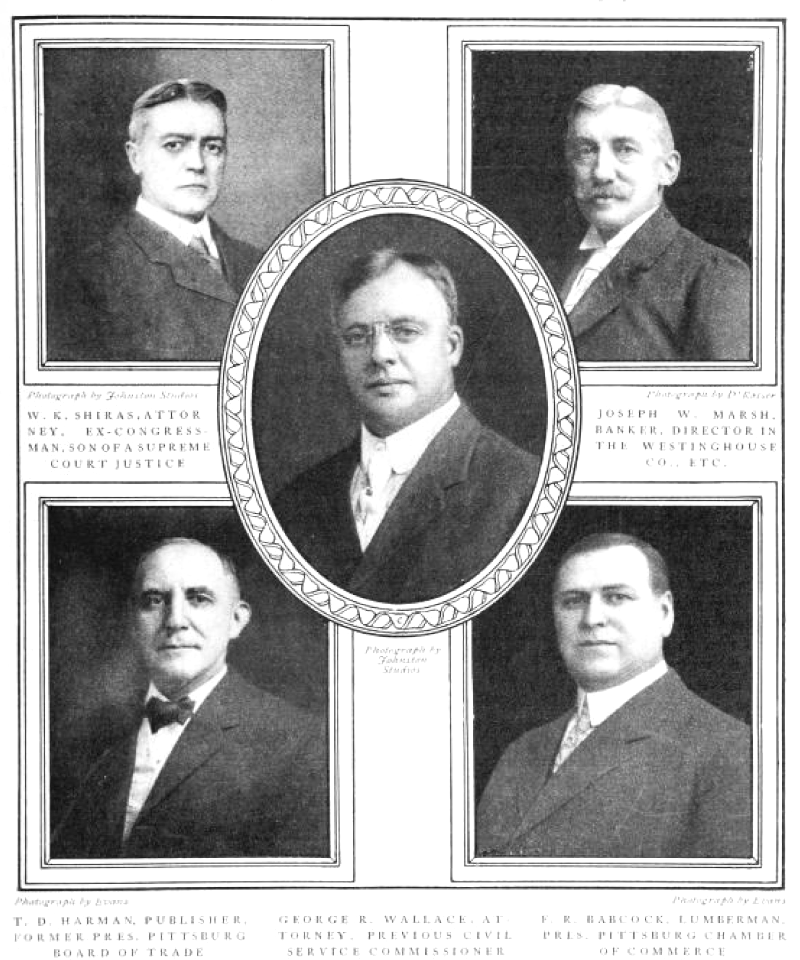
Something over a year and a half ago a loose-tongued reporter, chatting with a Pittsburg councilman, took a roll of $250 out of his pocket and remarked:
“Well, they have divided the bank swag—here’s mine!”
“How in the world do you come in for that?”’ the astonished councilman inquired, as soon as he could find his tongue.
“Don’t know,” replied the budding journalist indifferently, “because I’m a good fellow, I guess”—and putting the roll back in his pocket, he lounged away.
The councilman happened to be honest. Not many honest men were in the Pittsburg councils just then, but he was one of the few. Blind luck had put into his hand the first piece of direct evidence that bribery was responsible for the iniquitous bank ordinance of 1908—the ordinance that he himself with a few others, a scandalously small minority, had contested bitterly.
He lost no time getting up to an office on the eighth floor of the Frick Building where half a dozen men had gathered to hear his story. There was nothing remarkable about these men. They were not rich as Pittsburg lists its wealthy citizens, nor faddists nor professional reformers. They were only a handful of honest, solid men who were willing to risk something to help their town. They were of the sort that makes strong and patient fighters when put to it; cool-headed, far-sighted, determined, and knowing how to hold their tongues. Their leader was perhaps the most unusual figure among them. A. Leo Weil is a corporation lawyer and a Jew. He has practiced his profession for twenty-two years in Pittsburg—and beyond a living, he cares nothing whatever for money.
To get at what these men were doing, we must understand that Pittsburg’s deposits of city money amount to about $10,000,000 a year. Divided among, say, six banks, it comes to $1,600,000 apiece—a very neat little plum even for banks that think in millions as the Pittsburg banks are supposed to. Hence every four years, when the depositories are elected, there is not perhaps a scramble exactly, but a kind of unmistakable, earnest motion among the Pittsburg banks to get appointed. In the spring of 1908 the councils passed an ordinance naming six banks as depositories, and directing Mayor Guthrie to make contracts with them on their agreement to pay two per cent. interest on the deposits.
But five other banks of equal responsibility had also applied for appointment, offering to pay two and one half per cent. Why not appoint them? It was a matter of straight business for the city to get the best bargain it could. One half of one per cent. is five mills on the dollar; not much, but on a million and a half of dollars it counts up $7,500, and any thrifty public servant might see that the difference was worth pocketing. It was enough to pay the mayor’s salary, for instance, and a little more.
Mayor Guthrie vetoed the ordinance at once and used up a scholar’s vocabulary twice over in telling the councils what he thought of it. The councils were not impressed, not even interested. They simply sailed the measure over his veto at top speed, stood pat, and told the mayor that the next move was up to him.
Bribery! The thing was perfectly obvious. Enough councilmen had been bribed to turn the ordinance in favor of certain banks, so that they could get their appointment at a cheap rate at the city’s expense. Everybody knew it, but who could prove it—prove it, that is, with the kind of proof that would pass muster against political influence in a court, a Pennsylvania court, and an Allegheny County court?
It was a tall order and Mayor Guthrie could not fill it. He did his best. The police and city detective force under his command groped around a while perfunctorily, with one eye closed, got tired and reported failure. The mayor was helpless.
Then the men in the Frick Building took hold. They had already had their eye on the situation a long time, but they were not the kind to precipitate things prematurely and make a mess of them. Chance, pranking between the reporter and the honest councilman, had crystallized their indefinite suspicions and given them a start, and now they determined to go to work and do the thing that had been officially declared impossible. And they did it. It cost them nineteen months of hard, nervous work—the kind of work that saps a man, that makes his head ache, that makes him tired at the end of a year. It cost them money, business, antagonisms, miserable misunderstandings, the stress of resistance to golden temptations. Before they got through, it cost them the bitterness of seeing some of their best and oldest friends crushed in the machinery of the law that they had set in motion. Patriotism in Pennsylvania comes high, and civicism in Pittsburg comes especially high; but these men resolutely charged off every costly personal item to profit and loss and stood through to the end.
Here was the problem that faced them:
First, to secure unshakable evidence that the Pittsburg city councils could be bribed.
Second, to secure unshakable evidence that they had been bribed in the bank ordinance affair.
They decided that the best way to find out whether councilmen were approachable was to approach them; and that the best way to get incriminating evidence about the bank ordinance deal would be to get it from the councilmen themselves. Accordingly, they laid their plans in such a way as to make the one thing lead up naturally and inevitably to the other.
Two detectives came in from outside and posed as agents from a wood-block paving concern. To all appearances they were good, lively business men, high-grade salesmen, fully in the confidence of their employers, and with the wood-block situation at their tongues’ end. They considered Pittsburg carefully, looked up what was doing in the line of new pavement, made acquaintances in the way of business, and all told, behaved as good missionaries should. Occasionally they met a councilman or two in the Duquesne or Union Club, invited a couple of them to dinner once or twice, but made no especial point of cultivating them. When wood-block pavement came up in conversation, as of course it sometimes would, it came casually and naturally and never reached the point of propositions or particulars, The councilmen did all they could to show that they were hospitable toward the wood-paving idea, throwing out hints here and there that wood-block might he made to look like a good thing for Pittsburg if handled in the proper way, that there were means of getting such things convincingly represented to the councils, and so on; but the salesmen-detectives did not take the cue. The city fathers, used to a more straight-ahead style of bargaining, impatiently put these men down as back-number salesmen, who ought to be handling Sunday-school hooks for the Y. M. C. A. instead of selling wood-block to a municipal council. Indeed, John Klein, the councilman who first turned State’s evidence, afterward spoke of this phase of the investigation with plaintive disgust. “Those fellows never mentioned money,” he said; “all they did was to buy us fine dinners, and set up asparagus tips. Now, what the hell do councilmen know about asparagus tips?”
The missionaries disappeared presently, and for some time nothing more was heard of wood-block. The councilmen let the incident drop out of mind as a good chance lost through the stupidity of salesmen who were not up to date. Meanwhile, the men in the Frick Building had been in correspondence with a very remarkable man by the name of Robert Wilson, of Scranton.
Very little is known of Wilson up to the lime he appeared in Scranton, except that he had a trade—machinist—that he had worked as stoker, engineer, and roustabout on long sea voyages, and had been in about every country in the world. He drifted into Scranton as an itinerant preacher, and nightly harangued considerable crowds from the tail of a wagon. His preaching had some degree of power, and a good many who had listened out of curiosity got under conviction and remained to pray. Wilson worked at his permanent constituency until he judged he had them in shape to join a church, and then in the true democratic spirit took a vote on what church they should join. The majority declared for Presbyterianism, so the next Sunday morning Wilson marshaled his whole congregation to the nearest Presbyterian church and turned them over to the pastor.
Although Wilson had thus worked himself out of a job for the time being, he had attracted attention and won respect: and when Scranton decided to clean up its evil municipal conditions, and the Municipal League was formed, Wilson somehow gravitated to the head of the movement, carrying his religion with him. He never makes an immediate decision in any matter of importance, but goes to his room, gets down on his knees, and prays for light—and usually gets it. When some one asked him what methods he used in his new business of detective work—evidently thinking that his brilliant success was due to some new psychological theory—he said: “Suppose, now, I am on a graft case. I take my Bible and concordance, go up into the garret, say my prayers, and look up every reference in the Bible on the subject of graft. Tread them over and over till my mind is full of them, and then I go down to the city hall and hunt a grafter.” It is not cant—it’s all real.
This survivor of the Ironsides soon became the terror of lawbreakers in Scranton. No one knew where he was going to turn up next. He flitted about like a flesh-and-blood ghost—but he always was on hand at the right time in the right place. He had no end of adventures: his life was often threatened, and once or twice attempted at long range. Once he caught a number of men in a gambling house, arrested them all single-handed, and close-herded them down the street to the lock-up. They were enough of them to have eaten him alive, but it was Wilson, and they felt it would be cheaper in the long run to let him have his own way. A big man who reads the Bible for light, and says his prayers, and can fight like a grizzly bear in the consciousness that he is right, is a very, very hard man to interfere with.
And this was Wilson. The men in the Frick Building wrote to him explaining what was wanted, and asked him to come over to Pittsburg and help them out. Before he left Scranton he arranged with a wealthy lumberman there named Dolph to borrow his name for use in Pittsburg, The two men—Wilson and Dolph—look a good deal alike, so that Wilson might make a fair go of the impersonation under almost any circumstances, Taking a few assistants he slipped quietly into Pittsburg one night, and next day his assistants opened an office as agents of the old familiar game—wood-block pavement.
The trap was laid with splendid skill. Wilson went to live at the Fort Pitt Hotel, choosing a quiet room in a remote part of the building, where he improvised a kind of whispering gallery. He bored holes in the doors that led into adjacent rooms, fitted small megaphones into some of them, from the opposite side, and reamed out others: until the wood around them was thin as paper. An eye laid against these holes would command a clear view of everything taking place in his own room, and an ear at megaphones would hear every sound.
Meanwhile his associates had interviewed John Klein and William Brand, the councilmen who long ago had dined with the guileless wood-block missionaries at the Duquesne Club. They said they were representing the United States Lumber Co., and would like to do some business in Pittsburg. In fact, the house was so desirous to start something in the wood-paving line that they had prevailed on Mr. Dolph, one of their retired directors, to give the matter his personal attention. Mr. Dolph wanted very much to see some men who had influence in the councils, and he was now at the Fort Pitt Hotel. Would they go and talk it over with him?
Klein and Brand agreed. This was something like. Here, evidently, were men who were up to date, and ready to talk about something more animating than asparagus tips. They consented with alacrity, and were on hand at the Fort Pitt Hotel at the appointed time
Wilson was on hand, too, and four other men were concealed in the adjacent rooms. Two stenographers were at the megaphones, and the others at the eyeholes. Wilson received the councilmen with bland urbanity as became a retired director lending the weight of his dignity to get the house a fat contract, and the councilmen rested at ease. This, at last, was the real thing in wood-block.
After a few polite preliminaries, Wilson broached the matter of wood paving and talked about it most impressively. Pittsburg needed it, ought to have it. Pittsburg really could not know what good pavement was until it had tried his line. Now, it had occurred to him that while the city might be conservative about trying it on any large scale at first, it would perhaps consent to test it on some short street. A little influence would be very convenient in getting such an ordinance through, and he had been given to understand that Brand and Klein were very influential in the councils.… So he thought it might be well to inquire whether they could be interested, and perhaps they might be able to tell him whether such an ordinance might not somehow be slipped through.
“Sure, it’ll go through,” said Brand, tired of beating around the bush. “Sure thing!—if you put steam enough behind it.”
A happy smile of mutual understanding and indirection vanished. Wilson agreed to furnish steam; Klein and Brand to furnish ordinances as long as the steam held out. Then they sat down to talk it over, and their plans and projects ranged far afield. They became optimistic, enthusiastic. Pittsburg’s street mileage was nearly one third wood-block by the time the interview was over. And that was all for the day—duly noted by the hidden witnesses.
Wilson himself did not realize how completely he had taken these men in, nor the lengths they were prepared to go. After another interview or two, Klein and Brand seemed to think they ought to do something to show their confidence in Wilson’s intentions, though he had not yet given them a dollar of real money or offered a definite bargain. One day, to the utter amazement of Wilson and his associates—none of them dreamed of such a thing—Klein and Brand rushed an ordinance through the councils directing that Fourth Avenue should be paved with wood-block. Fourth Avenue! one of the main commercial thoroughfares of Pittsburg! Klein came back to Wilson in high feather. “That’s how we do things, you see,” he said. “One of us introduces it—then a motion to suspend the rules, bang!—then it goes through on first and second reading, bang! bang!—then finally it passes, bang!“
The men in the Frick Building had solved the first half of their problem. The Pittsburg councils could be bribed. Now for the second half—to prove that they had been bribed in the bank-ordinance affair.
Wilson was now so far in the confidence of Brand and Klein that he might easily have gotten them to talk about their past transactions in the councils. But grafters are kittle cattle, their suspicions are restless, and he judged it well to be on the safe side. So he expressed himself delighted with the Fourth Avenue ordinance, and divided up $1,360 between Brand, Klein, and Joseph C. Wasson—all in the presence of the hidden witnesses.
Wilson’s standing as a friend of crime was now settled beyond question. But he wanted more ordinances. He wanted lots of them and was willing to pay for all he could get. Klein and Brand had been very kind to give him the Fourth Avenue ordinance on credit, though of course they knew he was a gentleman and would pay. Still, for the future, it would be more businesslike to appoint a stakeholder. If they could recommend a good responsible banker, he would make a deposit, and then when any little paving job went through the councils, they need only step up and take the money. The banker, however, should be some thoroughly trustworthy person—that is, some one who had acted in a similar capacity before, or one, at all events, that they had enough hold on to be sure he would not betray them.
They said that in William W. Ramsey, president of the German National Bank of Pittsburg, they had the very man. Ramsey was safe, because they had him tied up in the bank-ordinance deal. Here was the long-sought opportunity.
Wilson was politely interested in the mention of the bank ordinances, and inquired about them. The councilmen told the story freely, proudly. Sums aggregating about $25,000 had been collected from certain favored banks for distribution among councilmen. Klein himself did most of the distributing, as usual. He said that whenever any grafting measure was put through, “they all waited for the angel of charity to walk—and I was the angel of charity.” Klein produced a list of the councils and checked off the men who did not participate; there were so few of them, he said, that it was easier to check them than to check the crooked ones. Most of the amounts were small. The councils, in Klein’s opinion, were pretty cheap—”a bum affair,” he called them. “Some could be bought for a suit of clothes or a five-dollar bill, and some with a postage stamp; others had to have more.”
Was this evidence enough? Here were Brand, Klein, Wasson, and a bank president all caught absolutely with the goods on them. Here was the testimony of two witnesses, sometimes three, who had looked on through the eyeholes at each interview that had taken place in Wilson’s room. Here were two stenographic reports of an immense amount of incriminating history. Surely this must be evidence enough for anybody.
For anybody, yes; but not for the men in the Frick Building. They had cut their eyeteeth. They had been in Pennsylvania courts already and knew the sort of work cut out for anyone who tries to match law and justice against Pennsylvania politics. A few months before, they had prosecuted a few of Senator Penrose’s high-priced hired men for issuing fraudulent tax receipts. The evidence in those cases, too, they thought was plenty good enough for anybody, and so indeed it was, but it did not convict—some of it did not even get in. One witness was railroaded out of the courtroom in open daylight, taken across to Allegheny, and kept in hiding until after the trial was over. The judge, furthermore, seemed to have his mind rigged with bulkheads for the occasion. Sometimes he gave signs of knowing a great deal about due process of law, and sometimes, again, he appeared not to know anything about anything—and the men in the Frick Building always lost out by these aberrations. One such experience was enough. They determined that in these investigations they were not going to raise the alarm until they had every exit safely blocked and the skylight spiked down.
By a happy inspiration it occurred to them that if the banks had given the councilmen $25,000, their books might show traces of a yellow-dog fund. If a posted examiner should come down on them unexpectedly, suddenly, and hold a special examination, he might find items that would establish a valuable line of collateral evidence. In this hope Mr. Weil went to Washington and laid the matter before President Roosevelt.
The President had just come in from a game of tennis, and was feeling particularly fit and vigorous that morning. During Mr. Weil’s recital he gritted his teeth, slapped Mr. Weil on the back at fairly merciful intervals—Mr. Weil is a small man—and called in the Comptroller of the Currency. Mr. Weil gained his point and they reached an agreement, rather reluctantly on the part of the government, and the special examination was ordered. The President threw the entire responsibility on Mr. Weil and threatened him with frightful retribution in case the examination turned up nothing but a mare’s nest. “If nothing comes of this,” he cried, punctuating his warning with slaps on Mr. Weil’s back, “somewhere—somehow—sometime—I’ll get you!” Thereupon he abruptly terminated the interview, gritting his teeth with great ferocity. It seemed to Mr. Weil a rather unnecessary display of excitement, as he was perfectly willing to take any amount of responsibility; but he was satisfied to accept his success with almost any kind of accompaniment.
The guess was a capital one. Almost at once the special inspector found convincing evidence on the books of the German National Bank of Pittsburg. Pressed for an explanation, the president and cashier made a full circumstantial confession of their guilt; but—the transaction had been between themselves and the councilmen only, and none of the other directors of the bank knew anything about it.
Such disproportionate differences in life are made by the little buts and provisos and unforeseen conditions that Fate lays down. This little unguessed circumstance made a crucial difference to the men in the Frick Building. They were not yet ready to come out into the open and enter prosecutions—far from it. They had Brand, Klein, Wasson, and the two bank officials, but what was that when there were so many councilmen and men higher up involved, and they wanted to get all of them? They were so near having them all, so very near, and yet they dared not risk further prosecutions on the strength of the evidence of Wilson, and his stenographers.
The Comptroller of the Currency rightly insisted that the other directors must be informed at once, and the directorate was so large that our men knew this meant making the news public property. Detective work was at an end. The directors were informed on Saturday, and informations against Brand, Wasson, Klein, and the two bank officers were made on the Monday following.
The stroke fell from a clear sky. From the day the young reporter distinguished himself until the Monday when the five men were taken into custody, not four persons in Pittsburg outside of those immediately concerned knew that anything was going on. The police did not know it, the city and county detectives did not know it, nobody knew it. When in the course of the prosecutions the masterly detective work of Wilson stood revealed, the Superintendent of Police said to Mr. Weil: “I don’t mind being beaten at my own game if I know it, but I must say it is a little hard to have a thing like this going on under my nose for all these months, and I never getting wind of it.”
But there was no more secrecy now, and the men in the Frick Building were driven out of shelter into the wild excitement of the town. They were abused and maligned by the peace-at-any-price kind of people for helping give the city a bad name—think of it! They were threatened and plotted against by the criminal element, and worst of all, misunderstood by the tariff-trained, gold-besotted consciousness so long dominant in Pittsburg, that thinks of political and civic interest only in terms of what one can get out of it. Press and people—the press covertly and suggestively, the people openly—impugned their motives. “What do these fellows want?” was the continual question. “Does Weil want to be judge? Well, let’s elect him and stop this mess; it’s ruining the town.” “Does Blakeley want to be governor? Well, let’s give it to him and cut all this stuff out; it hurts business.” This kind of thing was heard day in and out, and you hear it yet. There are people in Pittsburg now who can’t get it into their heads after nineteen months’ experience, that the men in the Frick Building want nothing but a clean town. To some it seems almost unconstitutional, this idea that men sprung from Pittsburg’s loins should show themselves capable of disinterested sacrifice for the public good.
The storm beat on. Our men were silent, discouraged, indeed, but not despondent. They knew the five who were on trial would be convicted, but knew equally well that they would take their dose, seal their lips, and shield their associates. One chance, a slender one, remained, and our men took it.
It centered in Klein; Klein, the ringleader who knew everything, remembered everything with the trained, clear-cut, photographic memory of a riverman (which he was): Klein, who had personally distributed most of the money among his associates, and could give off-hand the day, date, place, hour, the smallest detail of every transaction and the words of every conversation. Had they not seen the proof of his marvelous memory on the stenographers’ record of his imaginary collusion with Wilson? If Klein could only be gotten to confess; if he could somehow be induced to speak and make public what he knew!
Appeals had been taken in some of the cases, and Klein was frequently brought into court as a witness. Delicately, with Italian patience, the men in the Frick Building worked on him, titillated his weaknesses, encouraged his vanity, exasperated him with adroit little taunts about his willingness to he a scapegoat, ridiculed the foolishness of his impossible loyalty. Suggestion, continuous, pervasive suggestion surrounded him everywhere. It assailed him in the solitude of his prison. He gave no sign of its prevailing—he was jaunty, witty, apparently quite unmoved; but beneath the surface this persistent suggestion kept working until suddenly it reversed the whole current of his intentions. Late one night a mysterious, unkempt messenger handed in a note addressed A. Leo Weil. Personal, confidential and private. Mr. Weil broke open the note and the burden of anxiety fell from his strained and tired mind. Klein would confess.

Confess he did next day. By arrangement he was removed from prison, taken to the Frick Building, and there from two o’clock until eleven at night two stenographers were working at full speed upon his story. He spoke his whole memory out, shielding no one and favoring no one. Then he was taken back, and with a sense of immense elation and relief our men went about the completion of their task. They had won.
Immediately they sent for six or seven guilty councilmen, weaker brethren, as they judged, and most likely to be frightened into corroborating Klein’s story, and taking them one by one, broke the news that Klein had confessed. They assured each man that they knew every tack and turn of his dealings with the “angel of charity,” and gave liberal samples of what they knew—telling such items as, for instance, the several amounts he got, the denomination of the bills, the precise hour, place, and incidental circumstances of his meetings with Klein, and so on—little matters that could not possibly be known unless Klein had told them.
There was no resisting it; one after another the men broke down, confessed, and consented that their confessions should take record along with Klein’s. Then the scene shifted for the final act which was to take place in the court room where the appeals in the cases of the original five were being heard.
Numbers of guilty councilmen were among the spectators in the crowded court. The place had an unhealthy fascination for them. There was no terrifying appearance on the surface of the proceedings, no sign that they were in any danger, but the air was charged with a spirit of uneasiness and apprehension that quickly found its way from man to man. The District Attorney, obtaining permission to make a public announcement, stated that several of the councilmen implicated with the prisoners had already confessed; if others present desired to do likewise, one of the court would sit as a committing magistrate to hear them and every possible leniency, even to the suspension of sentence, would be granted; but those who did not avail themselves of this privilege at once would be informed against, and the law would take its course.
The murky silence of despair settled over the court room, and confession after confession began to creep in. A change of heart overnight brought more in next day. The hearing adjourned early, and one councilman, fearing the day of salvation would pass him by, pushed forward to tell his story just as the adjournment was announced. The judge told him with feigned indifference that he had no time to hear him then—he might manage it to-morrow maybe, or the day after. None of those who were holding out had any idea how many confessions really had been made, and the effect of this simple ruse on the part of the judge was marvelous. There were so many confessions already in then that the court and prosecutors did not care whether any more came in or not. For the next few days the councilmen, stampeding for the indefinite safety of a suspended sentence, besieged the committing magistrates in shoals.
The men in the Frick Building had done their day’s work.
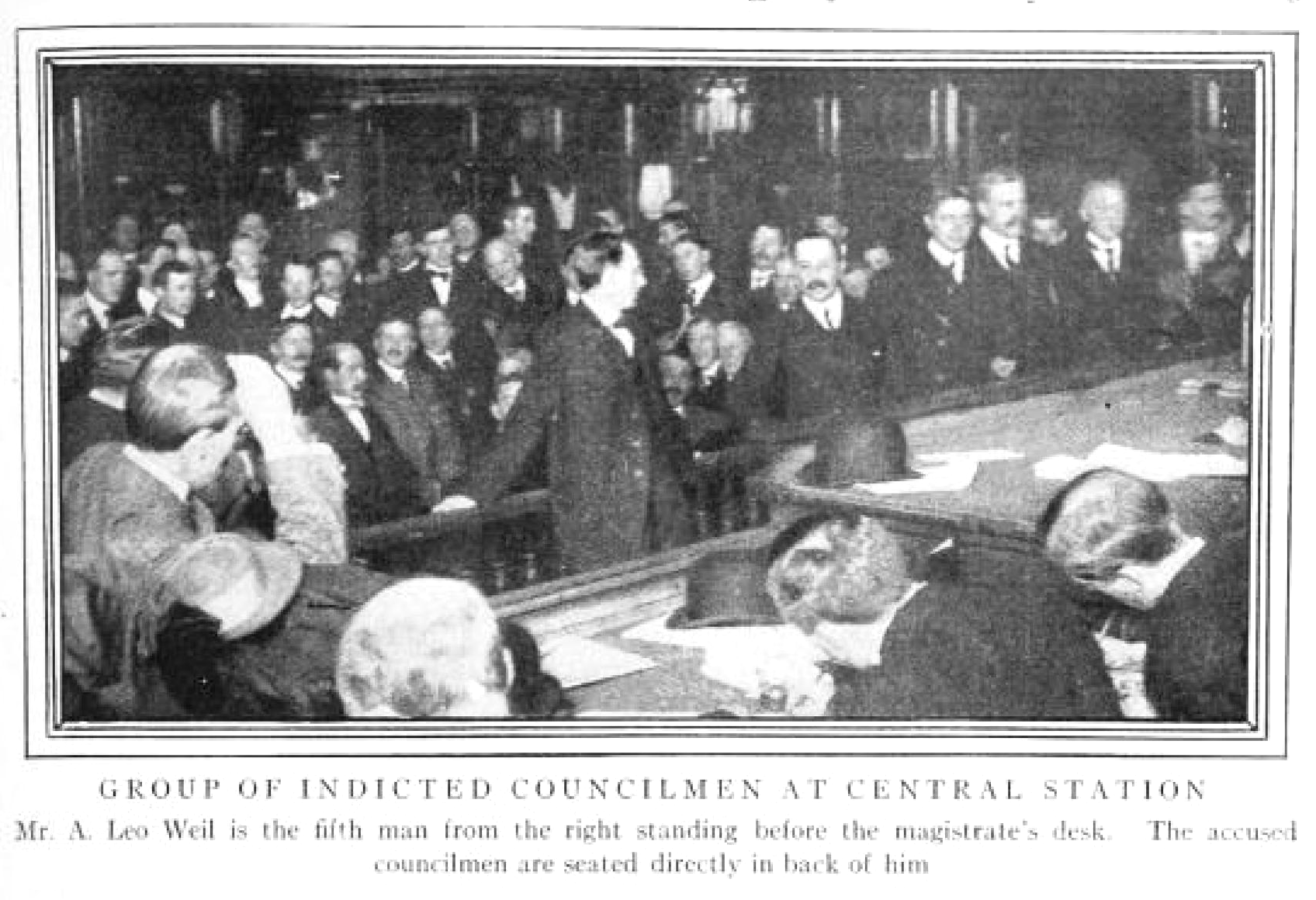
There are two separate sets of statistics showing what it all came to at the end of nineteen months. On the dockets and prison registers you may read of one hundred and eighty-six indictments and informations involving one hundred and sixteen persons, three of them bank presidents, several of them worth many millions. And of all this the end is not yet. But on the saddened faces of the men in the Frick Building you may also read that Mr. Weil is a life-long friend of one of the jailed millionaire bank presidents, and for years his personal attorney; that he is an intimate friend of the jailed vice president of the same bank; that he has lost $150,000 worth of business by his connection with these prosecutions; that W. K. Shiras has a valued client among the convicted men; that F. B. Babcock has a brother on the directorate of the Columbia Bank; that Willis F. McCook is vice president of the Workingman’s Savings, personal attorney and valued friend of the aged president who confessed to bribery and is now out on bail. It comes high indeed!
But these men are not deceiving themselves with the idea that a city can be regenerated by putting people in jail. They know that no town can purify itself until it takes on an entirely new philosophy of civic life and is educated into the saving graces of a new civic spirit, They have undertaken to represent this philosophy in Pittsburg and bear the pains of pioneering in the educational campaign; and right well, when all is said and done, is the city falling in with them. Pittsburg is not cleaned up yet by any means, but as a whole, it is unquestionably lifted a little out of the old bad ruts of thought. More and more the workaday world of Pittsburg is doubting the orthodox social philosophy; and many a man there has definitely broken with the old standard doctrine that good law, good politics, or even good business means always and necessarily and exclusively something that one can make money out of.
Is any amount of tariff protection worth having at the price of Penrose, Dalzell, Oliver, and the State, county, and city machines?
Is it worth having at the price of such civic conditions as exist in Pittsburg?
Is it worth having at the price of an industrial civilization of the kind prevailing in Pittsburg, Homestead, Braddock, and all that type of towns that William Cobbett called Hell-holes?
Is industrial supremacy worth having when overstrain exhausts the whole working population into abject apathy?
Are the great endowed technical schools worth having if they only train the next batch to a greater industrial “efficiency”’ than the present?
Are the magnificent libraries, art galleries, churches, and music halls worth having if the people they serve are too enervated to look or listen?
Is the iron-clad militant Protestantism of Pittsburg worth having if the city has to feel its way toward elementary social Christianity under the leadership of a Jew?
Ten years ago questions like these were never heard in Pittsburg. They are being asked now. Before long they will be answered.

Leave a Reply