
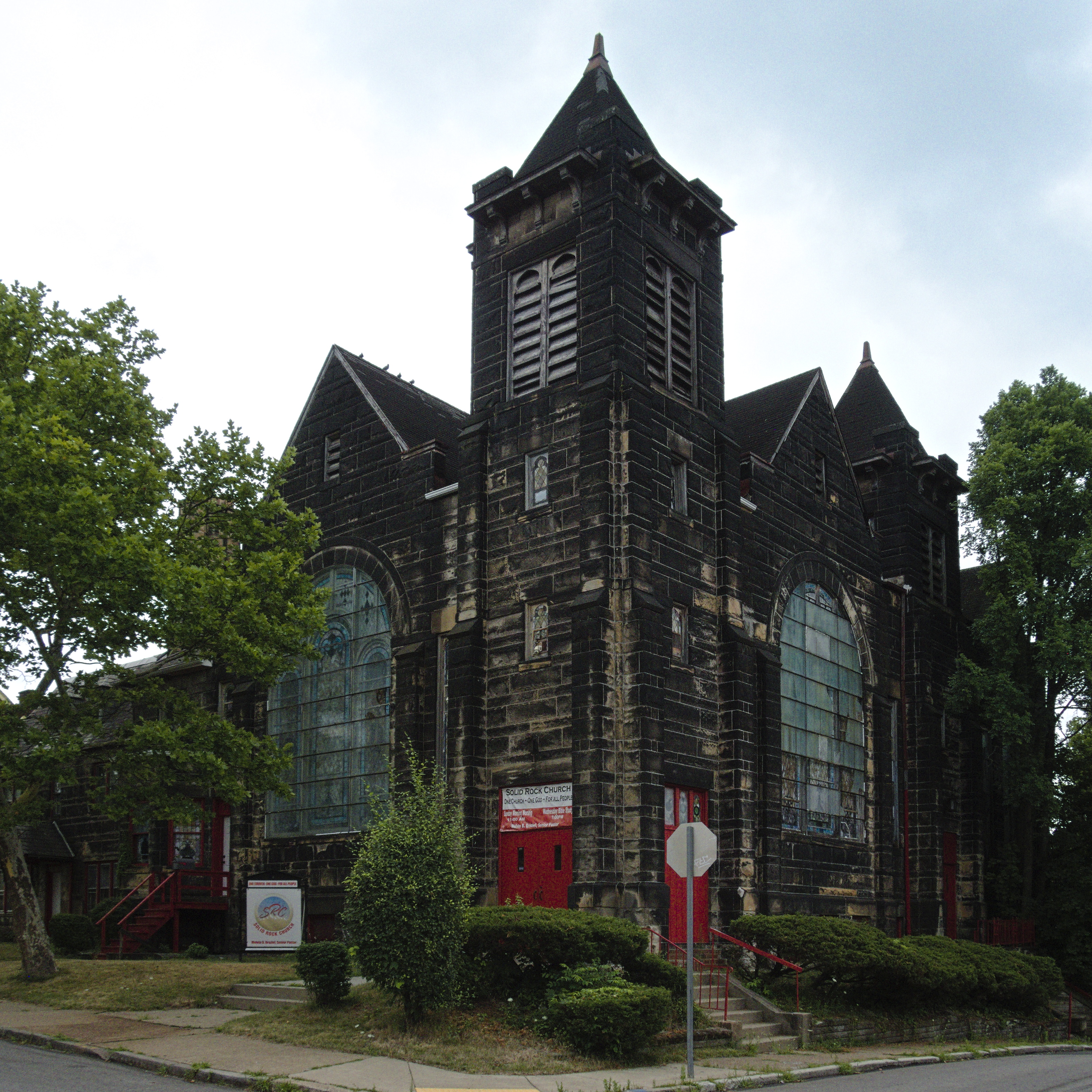
Few of these black stone buildings are left, but in some of the less prosperous neighborhoods we can still find uncleaned stones. Knoxville is a particularly interesting neighborhood from the point of view of the urban archaeologist: it was prosperous and now is not, so it retains some splendid buildings in their original state, many of them sadly abandoned and decaying. This church, marked “1st Meth. Prot. Ch.” on a 1916 map, is still in use as a nondenominational church, and old Pa Pitt very selfishly hopes that the congregation always sits at that middle point where it has enough money to keep the doors open and not enough to clean the black stones.

Addendum: The architect was Knoxville’s own Edwin V. Denick. “Fine New Church for Knoxville,” Pittsburg Press, November 1, 1908: “In the newly opened section of Knoxville, between Charles street and Rochelle street, the Knoxville Methodist Protestant Church congregation of the South Side is erecting a handsome stone building. The structure is under the direction of Edwin V. Denick, architect, and will occupy a plot 100×100 feet at the northeast corner of Zara street and Georgia avenue. The main auditorium will have a seating capacity of about 800. The subfloor is divided between gymnasium and The style is modernized Gothic in the exterior plan and design. The work is well in progress and it is intended to complete the structure about August 1, 1909.”
Leave a Reply